Top 10 Best Knife For Fighting: Savage Picks
Best knife for fighting choices often blend geometry, balance, and material science in ways casual buyers overlook. A fighting knife is not just about sharpness; blade profile, edge retention, steel composition, handle traction, and deployment speed all shape performance under pressure. The best knife for fighting can vary widely depending on tactical needs, concealability, durability, and grip security, while related options like combat knives and tactical blades bring their own strengths.
Modern manufacturing has also changed how full-tang construction, corrosion resistance, and ergonomic design influence real-world handling. That makes this category more complex than it first appears, especially when every detail can affect control, confidence, and reliability.
Understanding those differences is the key to separating hype from genuine capability, and the products ahead reveal why the right choice is rarely obvious at first glance.
Detailed Reviews of the Best Knife for Fighting
1. Tactical Spring Assisted Pocket Knife – Karambit Folding Knives for
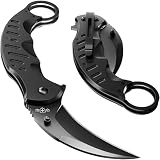
- Spring Assisted Karambit knife provides razor sharp cutting performance and high durability. Compact functional and stylish...
- Perfect tactical knife for everything - Camping, EDC, Hiking, Urban, Travel, Work, Self Defense, Bushcraft, Hunting, Fishing...
- Karambit knife features a handle ring for convenient forward and reverse grip. Lightweight and compact pocket CSGO karambit knife...
Best for: Compact karambit for discreet carry.
A 2.9-inch blade in 440C stainless steel gives this karambit a compact profile that can ride easily in a pocket while still delivering sharp cutting performance. The spring-assisted opening adds speed for quick one-handed deployment, and the aluminum handle keeps the knife light enough for everyday carry without feeling flimsy.
Hardening to 60 HRC gives the blade a tougher edge than many basic pocket knives, so it holds up better when the knife sees repeated use. The 7.6-inch overall length balances reach with concealability, and the 4.06-ounce weight keeps it manageable on a belt or in a pocket. A liner lock secures the blade in the open position, which matters when you need control during hard cutting tasks. The karambit shape also offers a hooked grip style that many users prefer for retention. For camping, hiking, travel, or urban carry, the size stays practical without becoming bulky.
Pros
- 440C stainless steel blade supports sharp, consistent cutting
- 60 HRC hardness helps the edge stay useful longer
- 2.9-inch blade keeps carry compact and discreet
- Aluminum handle and 4.06 oz weight reduce pocket bulk
Cons
- The 2.9-inch blade gives up cutting reach compared with full-size fighting knives.
For buyers who want a small, fast-opening tactical knife, this one keeps the format simple and carry-friendly. It makes the most sense for everyday pocket use where size and quick access matter more than reach.
| Specification | Details |
|---|---|
| Blade Material | 440C stainless steel |
| Handle Material | Aluminum |
| Lock Type | Liner lock |
| Blade Length | 2.9 inch |
| Overall Length | 7.6 inch |
| Weight | 4.06 oz |
| Blade Hardness | 60 HRC |
| Recommended Uses For Product | EDC, Camping, Self Defence |
I’d point this to someone who wants a compact fighting-style folder that is easy to carry every day. The short blade and light weight make it convenient, while the 440C steel and 60 HRC hardness give it more substance than a casual novelty knife. It is a better fit for portability and control than for maximum reach.
2. COLD STEEL Recon Tanto 7″ SK-5 Razor-Sharp Blade 4.75″ Kray-Ex

- COMBAT DESIGN: The Recon Tanto has been extensively used in various conflicts over the past two decades, earning its reputation as...
- SUPERIOR BLADE QUALITY: Crafted from SK-5 high-carbon steel, the Recon Tanto boasts a razor-sharp blade that delivers superior...
- DURABLE HANDLE: Designed for durability and secure grip, the Recon Tanto features a Kray-Ex handle that ensures optimal control...

Best for: Hard-use fixed blade with reach.
An SK-5 high-carbon steel blade gives the Recon Tanto the kind of edge retention and abrasion resistance that matters when a fighting knife has to stay sharp through hard use. The 7-inch blade format adds serious reach, while the Kray-Ex handle gives a secure grip for control under pressure.
Cold Steel pairs the tanto profile with a fixed-blade layout, so there is no folding mechanism to slow access or add play. The 4.75-inch Kray-Ex handle gives enough purchase for a full hand, and the included sheath makes belt carry straightforward. At adult size, it suits users who want a larger fighting-oriented knife rather than a compact pocket option. The steel’s high-carbon construction favors demanding use, while the blade geometry puts power into the point for work where penetration and tip strength matter. For hunting or field carry, the knife reads as a serious tool rather than a lightweight everyday folder.
Pros
- SK-5 high-carbon steel supports strong edge retention
- 7-inch blade adds reach for fighting-oriented carry
- Fixed-blade construction removes folding complexity
- Kray-Ex handle improves grip security
Cons
- The 7-inch blade and fixed design make it less discreet than a pocket knife.
This is the choice for buyers who want a larger combat-style fixed blade with a strong steel choice. It fits best when reach, blade strength, and fast sheath carry matter more than low-profile everyday carry.
| Specification | Details |
|---|---|
| Blade Material | SK-5 high-carbon steel |
| Blade Length | 7 inch |
| Handle Material | Kray-Ex |
| Included Components | Sheath |
| Model Number | 49LRT |
| Item Type Name | Fixed Knife |
| Recommended Uses For Product | Hunting |
| Age Range Description | Adult |
I’d steer someone here if they want a fixed blade with real reach and a steel known for hard use. The tanto blade shape and high-carbon SK-5 construction make it better suited to serious field carry than casual pocket duty. It’s a strong pick for buyers who value a rigid knife and a confident grip.
3. Fixed Blade Knife with Sheath, Heavy Duty Machete Gifts for

- Premium D2 Steel: Crafted from high-quality D2 steel, this survival camping knife offers outstanding hardness and long-lasting...
- 6mm Thick Spine: Built with an ultra-thick 6mm spine, this survival machete delivers exceptional durability and powerful chopping...
- Non-Slip Handle: The ergonomic synthetic rubber handle provides a secure, comfortable grip even in wet or harsh conditions. Paired...
Best for: Heavy-duty survival chopper.
Premium D2 steel gives this fixed blade a hard, wear-resistant edge that suits cutting, slicing, and survival work. The 6mm spine is the standout feature, adding the thickness needed for chopping, wood splitting, and brush clearing without the blade feeling fragile in hard outdoor use.
Freelander keeps the knife in a fixed-blade format with one-piece simplicity, which is useful when the priority is strength over compact carry. D2 steel is known for hardness and long-lasting sharpness, so the blade is aimed at repeated work rather than occasional use. The sheath is included for transport and storage, and the adult-sized build matches camping and outdoor survival roles. The thick spine helps the knife handle impact better than thinner blades, especially when splitting kindling or clearing small branches. As a single-piece package, it suits buyers who want a no-frills field knife for demanding tasks rather than a specialized fighting folder.
Pros
- D2 steel supports long-lasting sharpness
- 6mm spine improves chopping strength
- Fixed-blade design adds structural confidence
- Included sheath helps with carry and storage
Cons
- The thick 6mm spine adds bulk that makes it less convenient for light everyday carry.
Buyers looking for a tougher outdoor blade will appreciate the thick spine and D2 steel here. It makes the most sense for survival-minded use where chopping strength matters more than slim carry.
| Specification | Details |
|---|---|
| Blade Material | D2 steel |
| Spine Thickness | 6mm |
| Included Components | Sheath |
| Number of Items | 1 |
| Unit Count | 1 Count |
| Recommended Uses For Product | Outdoor, Camping |
| Brand Name | Freelander |
| Age Range Description | Adult |
I’d recommend this to someone who wants a hard-use survival knife more than a compact blade. The D2 steel and 6mm spine point to a tool that can take rough outdoor tasks seriously. If your priorities are chopping and field work, this one is easier to justify than a thinner tactical knife.
4. 11.5″ Tactical Survival Knife with Sheath – 6.5″ Fixed Full

- Black tactical survival knife for men with sheath, serrated blade and rubber ergonomic handle. Full tang knife is made of high...
- Razor Sharp Edge & Serrated Blade. Fixed blade knife has a sharp edge for precise slicing, partially serrated blade easily saws...
- Full Tang for Maximum Strength. The suvival knife with a full tang construction, where the blade runs through the entire handle...
Best for: Large tactical blade with serrations.
A 6.7-inch 440C stainless steel blade gives this tactical survival knife the length and corrosion resistance that matter for outdoor carry and fighting use. The serrated section adds cutting versatility, while the 11.65-inch overall length gives it the presence of a full-size fixed blade without giving up precise slicing capability.
Grand Way combines a full tang build with a rubber ergonomic handle, which helps the knife stay controllable during forceful cutting. The 7-ounce weight keeps it lighter than many larger survival knives, and the black oxide finish reduces reflectivity for a lower-profile look. Serrations help saw through rope and tougher materials, so the knife handles utility work as well as defensive tasks. The included sheath makes it easier to carry on a belt, and the adult sizing suits campers, hikers, and emergency users who want a longer fixed blade. The straight cutting edge and serrated section give it two distinct cutting zones for different jobs.
Pros
- 440C stainless steel resists corrosion
- 6.7-inch blade offers strong reach
- Serrated section helps with rope and tough materials
- Rubber ergonomic handle improves control
Cons
- The 11.65-inch overall length is bulky for concealed or pocket carry.
This is a practical pick for buyers who want a large fixed blade with both plain-edge and serrated cutting zones. It works best for outdoor carry, emergency use, and users who want more blade length than a compact knife offers.
| Specification | Details |
|---|---|
| Blade Material | 440C stainless steel |
| Overall Length | 11.65” |
| Blade Length | 6.7” |
| Handle Length | 4.95” |
| Weight | 7 oz |
| Handle Material | Rubber |
| Finish | Black oxide |
| Included Components | Sheath |
I’d choose this for someone who wants a larger tactical knife that still carries some utility value. The serrations and full tang make it useful beyond fighting-style carry, especially for rope, brush, or emergency work. It’s a sensible option if you want a bigger blade with a more practical outdoor profile.
5. KA-BAR Full Size US Marine Corps Straight Edge Fixed Blade

- Edge Angles - 20 Degrees
- Overall length 11.875 inches
Best for: Classic fighting knife profile.
An 11.875-inch overall length gives the KA-BAR full-size fighting knife the reach and hand spacing that made this pattern famous. The straight edge and 20-degree edge angle point it toward strong, controlled cutting, while the 100% leather sheath keeps the carry traditional and straightforward.
Made in the USA, this fixed blade is aimed at close combat, camping, and hunting use, so its shape is rooted in a long-standing fighting knife design. The straight edge favors clean slicing and controlled cuts, and the 20-degree angle gives a defined working edge for practical use. The knife ships as a single blade with separate packaging for the knife and sheath, which keeps the setup simple. Its adult size and full-length format make it better for belt carry than pocket carry. Buyers who want a historically recognized fighting knife will appreciate the no-nonsense layout and the leather sheath that matches the classic profile.
Pros
- 11.875-inch overall length adds reach
- 20-degree edge angle supports controlled cutting
- 100% leather sheath matches belt carry use
- Made in the USA construction appeals to traditional buyers
Cons
- The full-size fixed blade is too large for discreet everyday pocket carry.
For buyers who want a classic fighting knife shape, this KA-BAR stays true to the pattern. It suits users who value reach, a straight edge, and a time-tested fixed-blade format.
| Specification | Details |
|---|---|
| Overall Length | 11.875 inches |
| Edge Angles | 20 Degrees |
| Included Components | Knife |
| Sheath Material | 100% Leather |
| Recommended Uses For Product | Close combat, Camping, Hunting |
| Brand Name | Ka-Bar |
| Model Name | USMC KA-BAR FIGHTING KNIFE |
| Country of Origin | Made in the USA |
I’d point this to someone who wants the classic fighting-knife silhouette rather than a modern tactical folder. The long blade and leather sheath are part of what makes it appealing, and the straight-edge format feels deliberate. It’s a strong choice for traditionalists who want a recognizable belt knife with real presence.
6. Smith & Wesson 9″ H.R.T Double Edged Boot Knife with

- DIMENSIONS: 9 inch (22.9 centimeter) overall length with a blade length of 4.7 inches (12.1 centimeter) and a weight of 7.7 ounces
- DURABLE: Blade is made of reliable 7Cr17MoV high carbon stainless steel with a black rubber wrapped handle
- DEPENDABLE: Quick and easy access with the convenient belt or boot sheath making it ideal for everyday carry
Best for: Boot knife with quick access.
A 4.7-inch blade and 9-inch overall length make this boot knife compact enough for close carry while still offering a usable fixed blade. The 7Cr17MoV high carbon stainless steel adds durability, and the black rubber wrapped handle improves grip when fast access matters.
Smith & Wesson pairs the double-edged style with a belt or boot sheath, which makes carry options more flexible than a standard pocket knife. The 7.7-ounce weight gives it enough substance to feel secure without turning it into a heavy load. A hand guard adds retention, helping keep the blade from slipping during use. The lanyard hole gives another carry or security option, especially if the knife is stored where fast access matters. For buyers who want a concealed fixed blade for outdoor carry or emergency use, the smaller dimensions make this easier to place than a larger fighting knife. It suits hunting and general preparedness roles well.
Pros
- 4.7-inch blade stays compact for boot carry
- 7Cr17MoV stainless steel adds durable utility
- Belt or boot sheath supports fast access
- Hand guard improves grip security
Cons
- The short 9-inch overall length limits reach compared with full-size fighting knives.
This boot knife works best for buyers who want compact fixed-blade access rather than long reach. It is a practical fit for concealed carry setups where the sheath location matters as much as the blade itself.
| Specification | Details |
|---|---|
| Overall Length | 9 inch |
| Blade Length | 4.7 inches |
| Weight | 7.7 ounces |
| Blade Material | 7Cr17MoV high carbon stainless steel |
| Handle Material | black rubber wrapped |
| Included Components | 9″ H.R.T Double Edged Boot Knife |
| Model Number | SWHRT9BC |
| Recommended Uses For Product | Hunting |
I’d recommend this to someone who wants a compact fixed blade for boot or belt carry. The size is much easier to place than a large combat knife, and the hand guard plus rubber handle help with control. It makes sense for buyers who value portability and quick access over maximum blade length.
7. FLISSA Survival Hunting Knife with Sheath, 15-inch Tactical Bowie Knife
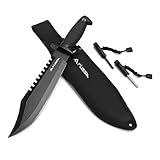
- 15" Fixed Blade Hunting Knife: Ultra-sharp combat knife, stronger than traditional hunting or bowie knives. Overall Length...
- Razor Sharp Clip Point Blade: Made of stainless steel for excellent hardness, improved edge retention, and rust resistance. The...
- Hunting Knife with Sheath & Rubber Handle: The classic soft rubber handle provides high friction and a comfortable, non-slip grip...
Best for: Oversized bowie for outdoor force.
A 10-inch clip-point blade gives this 15-inch survival knife the reach and chopping presence of a true oversized bowie. The stainless steel construction adds hardness and rust resistance, while the 5/32-inch thickness gives the blade the backbone needed for rough outdoor work.
FLISSA adds a saw back to the blade, which gives the knife more utility for camp and survival tasks beyond plain slicing. At 16.8 ounces, it carries more weight than smaller fighting knives, and that weight supports chopping momentum. The black anodized finish cuts glare and gives the blade a more subdued look in the field. The included sheath helps when carrying the knife on hikes or during camping trips, and the adult sizing matches users who want a large outdoor knife rather than a compact defender. The blade length, thickness, and saw back combine to make this a field-first tool with fighting-style proportions.
Pros
- 10-inch blade gives strong reach and chopping range
- 5/32-inch thickness adds blade strength
- Saw back increases utility for field tasks
- Stainless steel construction improves rust resistance
Cons
- The 16.8 oz weight makes it too large for light everyday carry.
Buyers who want a big survival knife with bowie proportions will find a lot to like here. It is most useful when chopping power and field versatility matter more than portability.
| Specification | Details |
|---|---|
| Overall Length | 15 inches |
| Blade Length | 10 inches |
| Thickness | 5/32 inch |
| Weight | 16.8 oz |
| Blade Material | Stainless steel |
| Finish | Black anodized |
| Included Components | Knife, Vagina, Blade, Lighter |
| Recommended Uses For Product | Camping, Hiking, Hunting |
I’d suggest this for someone who wants a large outdoor knife with real chopping mass. The size and thickness make it more useful as a survival tool than as a discreet defensive blade. It fits buyers who are comfortable carrying a bigger knife and want the added utility of the saw back.
8. Purple Dragon Tanto Knife with Sheath – Japanese Fixed Blade

- Uncompromising Construction: Forged from a single billet of D2 tool steel—no welds, no weak links. The hand-wet-ground convex...
- Reduced Drag, Reinforced Tip: A fuller reduces surface contact along the blade, allowing you to cut deeper with less drag—and...
- Vice-Like Grip & Control: Black G10 handle, triple-riveted with aggressive texturing for a vice-like grip. The double guard keeps...
Best for: Single-piece D2 steel tanto.
Forged from a single billet of D2 tool steel, this tanto knife avoids welds and joints that can become weak points under stress. The convex edge and reinforced tip give it a hard-use profile that suits chopping brush and batoning hardwood better than a thin general-purpose blade.
Purple Dragon leans into a fixed-blade, single-billet design, which is the key appeal for buyers who want structural simplicity. The fuller reduces blade drag, so cuts can feel smoother when the knife is moving through material. The tanto tip adds strength at the point, making it useful where tip durability matters. The included sheath keeps the knife ready for belt or pack carry, and the adult sizing fits outdoor use. While the product is marketed for camping, its steel choice and reinforced geometry also suit users who want a knife that can handle aggressive field work. The core value here is a rigid blade with fewer failure points than a folder.
Pros
- Single-billet D2 tool steel removes welded weak points
- Convex edge supports aggressive cutting
- Fuller reduces drag through material
- Reinforced tanto tip improves point strength
Cons
- The fixed-blade format is less convenient for pocket carry than a folding knife.
This knife is a strong fit for buyers who want a hard-use fixed blade with a reinforced tip and a simplified construction. It makes the most sense for outdoor carry where strength matters more than compactness.
| Specification | Details |
|---|---|
| Blade Material | D2 tool steel |
| Model Name | Purple Dragon Tanto Knife |
| Included Components | Sheath |
| Model Number | TKNIFE18-JST-XLM |
| Recommended Uses For Product | Camping |
| Age Range Description | Adult |
| Unit Count | 1 Count |
| Number of Items | 1 |
I’d recommend this to someone who values blade integrity and a reinforced tip over compact carry. The single-billet D2 construction is the main reason to buy it, especially if you want a knife that feels purposefully tough. It’s a better match for field abuse than for casual pocket use.
9. RTCT Polypropylene Training Daggers Leatherneck S/F Trainer (2 Pack) Black

- HIGH-QUALITY MATERIAL: Made from lightweight and durable polypropylene, designed to minimize training injuries while simulating...
- SAFE DESIGN: Ideal for Krav Maga and self-defense practice with almost zero chance of injury, suitable for solo practice and...
- VERSATILE USE: Perfect for cosplay, military training, martial arts practice, and more, supporting a variety of training...
Best for: Safe practice blades in two-pack.
Two polypropylene training daggers make this set a practical choice for practicing fighting grips and movement without a live edge. The lightweight plastic construction lets teens and adults work on control, spacing, and handling with far less risk than a steel blade.
RTCT packages two trainers in one set, which matters if you want partner drills or a spare blade for repeated practice. Polypropylene is the key material here, since it gives the feel of a training knife without the cutting edge of a real one. The set name and product type make clear that these are training knives, not carry blades. Adult and teen age suitability broadens who can use them for martial arts or self-defense practice. The black finish keeps them visually close to a tactical training tool, and the simple package makes storage easy. For anyone studying knife retention, disarms, or movement, the set is about safe repetition rather than field use.
Pros
- Polypropylene construction supports safer practice
- Two knives allow partner drills
- Training-only format avoids live-edge risk
- Teen and adult suitability broadens use
Cons
- These are training knives only, so they cannot be used as real fighting blades.
This set is for practice, not carry, and that is exactly the point. It suits buyers who want to train with two matching daggers and keep the risk lower while working on technique.
| Specification | Details |
|---|---|
| Material | Polypropylene |
| Included Components | Two training knives |
| Number of Items | 2 |
| Unit Count | 2 Count |
| Recommended Uses For Product | Training |
| Age Range Description | Teen,Adults |
| Set Name | RTCT Polypropylene Training Daggers (2 Pack) |
| Model Name | II8989 |
I’d pick this for someone focused on practice rather than ownership of a live blade. The two-pack format is useful for drills, and polypropylene makes it a better training tool than a metal knife. It is the clear choice for users who want repetition, not cutting performance.
10. GOOD WORKER Legal Pocket Knife with 2.95” Serrated Blade, Glass

- Black pocket knife with serrated blade and aluminum ergonomic handle. Pocket knife is made of 440C stainless steel. Lock type...
- Legal in All States. Pocket knives (no spring) with blade under 3 INCHES are primarily tools and generally legal to own and carry...
- All-In-One Knife: compact, versatile, and ready for anything. This small pocket knife is essential for everyday versatility...
Best for: Legal carry with rescue tools.
A 2.95-inch serrated 440C stainless steel blade keeps this folding knife under the size limit while adding practical cutting power. The aluminum ergonomic handle and liner lock give it a familiar pocket-knife feel, and the built-in seatbelt cutter and glass breaker make it more than a simple blade.
GOOD WORKER combines three emergency tools in one pocket knife: a seatbelt cutter, a glass breaker, and a serrated blade. The 7.17-inch overall length and 4.12-ounce weight keep it compact enough for everyday pocket carry, while the 4.2-inch handle provides enough grip area for controlled use. Because the blade stays under 3 inches and has no spring, the knife is positioned as a general tool rather than a tactical automatic. The pocket clip improves access, and the liner lock secures the blade during use. For buyers who want a carry knife with rescue functions and a legal-minded profile, the data points to utility first and blade aggression second.
Pros
- 2.95-inch blade keeps carry compact
- 440C stainless steel adds durable cutting performance
- Seatbelt cutter and glass breaker improve emergency utility
- Pocket clip and liner lock support everyday carry
Cons
- The sub-3-inch blade gives up reach compared with larger fighting-style knives.
This is the practical option for buyers who want a pocket knife with rescue features rather than a full fighting blade. It is best when carry legality, compact size, and multi-tool utility matter most.
| Specification | Details |
|---|---|
| Blade Material | 440C stainless steel |
| Blade Length | 2.95” |
| Handle Length | 4.2” |
| Overall Length | 7.17” |
| Weight | 4.12 oz |
| Handle Material | Aluminum ergonomic handle |
| Lock Type | Liner lock |
I’d recommend this to someone who wants a carry knife with practical rescue tools more than a pure fighting knife. The seatbelt cutter and glass breaker are the main reasons to choose it, and the compact blade makes everyday carry easier. It fits users who want utility and portability in one pocket tool.
Quick Comparison Table of Best Fighting Knives
| Product Name | Blade Type | Blade Steel | Length | Best For | Check Price |
|---|---|---|---|---|---|
| Tactical Spring Assisted Pocket Knife | Karambit folder | 440C steel | 2.0 inch | EDC self defense | Check Price |
| COLD STEEL Recon Tanto 7″ SK-5 | Fixed tanto | SK-5 steel | 7 inch | Combat use | Check Price |
| Fixed Blade Knife with Sheath, Heavy | Fixed blade | D2 steel | 6mm spine | Outdoor survival | Check Price |
| 11.5″ Tactical Survival Knife with Sheath | Fixed survival | 440C steel | 6.7 inch | Fighting and camping | Check Price |
| KA-BAR Full Size US Marine Corps | Fixed straight edge | Steel | 11.875 inch | Close combat | Check Price |
| Smith & Wesson 9″ H.R.T Double | Double-edged boot knife | 7Cr17MoV steel | 4.7 inch | Boot carry | Check Price |
| FLISSA Survival Hunting Knife with Sheath | Tactical bowie | Stainless steel | 10 inch | Hunting and defense | Check Price |
| Purple Dragon Tanto Knife with Sheath | Fixed tanto | D2 tool steel | Tanto blade | Heavy-duty use | Check Price |
| RTCT Polypropylene Training Daggers Leatherneck S/F | Training dagger | Polypropylene | Trainer size | Practice drills | Check Price |
| GOOD WORKER Legal Pocket Knife with | Serrated pocket knife | 440C steel | 2.95 inch | Legal carry | Check Price |
How to Choose the Right best knife for fighting
Blade geometry and edge profile
Choose the blade geometry that matches the way you actually carry and use the knife. A fixed blade gives the most stable platform, the least moving parts, and the fastest access under stress, while a folder adds compact carry and easier everyday concealment. For control, pick a blade around 3 to 4 inches; shorter gives better precision, longer adds reach without becoming clumsy.
A drop point or spear point gives a strong tip and clean alignment, while a tanto favors tip durability. Prefer a plain edge for simple sharpening and reliable cutting; serrations suit buyers who need aggressive bite on fibrous material.
| Type | Best for |
|---|---|
| Fixed blade | Maximum stability and fast access |
| Folding blade | Compact pocket carry and discretion |
| Drop point | Balanced tip strength and control |
| Tanto | Hard-use tip and puncture strength |
Steel quality and heat treatment
Steel choice should match hard use, not just a shiny finish. For field carry, corrosion resistance matters, so look for stainless steels with a proven outdoor record and a uniform heat treatment from a reputable maker. For heavy use, edge retention matters more than raw hardness, and a good fighting knife keeps its bite through repeated cutting without chipping.
The best balance comes from a steel that sharpens cleanly, resists rust, and stays tough under impact. Avoid vague steel claims and inconsistent batch work; consistent tempering matters as much as the alloy itself.
Pick stainless for wet climates and a tougher edge profile for hard-duty users.
| Steel focus | Best for |
|---|---|
| High corrosion resistance | Wet, humid, or maritime carry |
| High edge retention | Extended use with fewer touch-ups |
| High toughness | Rough handling and impact resistance |
| Consistent heat treatment | Reliable performance across the blade |
Handle design and grip security
Grip security comes first, because a fighting knife needs to stay planted in the hand when sweat, rain, or gloves enter the picture. Choose textured scales, checkered G10, rubberized overlays, or contoured micarta that lock in without feeling abrasive. A straight, flat handle works for quick indexing, while a tapered or palm-swelling profile adds comfort during longer carry.
Look for a guard, thumb ramp, finger choil, or prominent choil area that gives a hard stop and improves retention in forward or reverse grip. A balanced knife with no hot spots lets you hold it longer without fatigue.
Pick a grippy, contoured handle with a real guard for users who want maximum control.
| Handle style | Best for |
|---|---|
| G10 or micarta with texture | Secure grip in wet conditions |
| Rubberized scale | Glove use and maximum traction |
| Contoured profile | Longer carry and reduced hand fatigue |
| Pronounced guard/choil | Retention and grip indexing |
Carry, deployment, and accessibility
Carry and deployment should feel immediate, secure, and unobtrusive. A fixed blade needs a sheath with strong retention, smooth draw, and mounting options that stay put on a belt, pack, or vest; weak clips and loose fit are poor signs. For folders, look for deep-carry clips, strong detents or locks, and opening methods you can use without fumbling.
One-hand access matters, but the knife should still resist accidental opening in a pocket or sheath. Weight and size matter too: lighter knives disappear better, while heavier ones carry better on a belt.
Pick a fixed blade for secure exterior carry and a folder for pocket-friendly access.
| Carry type | Best for |
|---|---|
| Secure sheath carry | Fixed blades and belt mounting |
| Deep-carry clip | Low-profile pocket carry |
| Strong lock and detent | Fast, one-hand folder access |
| Lighter weight | Everyday concealment and comfort |
Build quality and legal considerations
Build quality and legality decide whether the knife stays dependable and lawful. A full tang gives the strongest structure for hard use, especially on fixed blades, and it should feel like one continuous piece rather than a hollow, flexy assembly. Check for tight fasteners, flush scales, clean grinds, and no blade play or rough opening action.
Maintenance also matters: rust-prone finishes need more care, while simpler constructions last longer with less attention. Before buying, confirm local blade-length and carry rules so the knife fits your area without trouble.
Choose a full-tang, tightly finished knife for maximum durability and a compact legal carry length for everyday buyers.
Which Should You Choose?
- If you want a compact option for everyday carry and close-quarters utility, choose a small folding knife with a karambit-style ring and a spring-assisted opening.
- If you need a hard-use fixed blade for serious tactical feel and maximum stabbing power, choose a tanto-style blade around 7 inches with a full-size grip and a razor-sharp point.
- If you prefer a dependable all-purpose fighting knife with strong slicing ability, choose a full-tang fixed blade with a 4.5- to 6.5-inch blade and a sheath.
- If you want the most compact concealed-carry style for backup use, choose a boot knife or double-edged fixed blade with an overall length under 10 inches.
Quick Best Knife For Fighting Buying Checklist
- Choose a fixed-blade design for maximum strength, stability, and fewer moving parts.
- Check blade length and balance to make sure the knife feels controllable in hand.
- Prioritize a secure grip with textured scales, a pronounced guard, or a deep finger choil.
- Inspect the steel and heat treatment for dependable toughness, corrosion resistance, and edge retention.
- Review sheath quality so the knife stays locked in place and is easy to access safely.
- Confirm local carry laws before buying to avoid legal issues with blade length or concealment rules.
How a Fighting Knife Design Actually Performs
A fighting knife is shaped to support fast deployment, secure handling, and controlled cuts in close quarters. Most designs emphasize balance, grip retention, and a point that can penetrate efficiently without making the blade cumbersome. Blade geometry matters because a thinner, narrower profile typically moves more easily, while a broader blade can feel stronger in hand.
Handle texture and guard shape also affect performance by reducing the chance of slipping during rapid movement. In practice, the best design is the one that stays predictable under stress and lets the user maintain control with minimal adjustment.
Fixed Blade vs Folding Knife in Defensive Use
Fixed blades are generally favored for fighting because they are simpler, stronger, and ready without opening mechanisms. They usually have fewer moving parts, which reduces the chance of failure under pressure. Folding knives can be more compact and discreet, but lock strength, opening speed, and pocket deployment become important concerns.
For a defensive context, a folding knife must have a reliable lock and a design that can be brought into action consistently. The trade-off is straightforward: fixed blades prioritize durability and immediate use, while folders prioritize portability and everyday carry convenience.
| Type | Best for | Main trade-off |
|---|---|---|
| Fixed blade | Immediate access and strength | Less compact to carry |
| Folding knife | Discreet everyday carry | Mechanism adds complexity |
| Assisted-opening folder | Fast one-handed access | Lock and deployment depend on design |
Steel, Edge Geometry, and Retention
The blade material and edge shape influence how a knife behaves in real use. Tough steels can resist chipping better, while harder steels often hold an edge longer but may require more careful maintenance. Edge geometry also affects cutting efficiency and durability; thinner edges slice more easily, while thicker edges can be more forgiving under strain.
A fighting knife does not need the same geometry as a survival blade, because maneuverability and control are usually more important than brute cutting power. Choosing a blade that balances edge retention, toughness, and ease of sharpening helps keep performance consistent over time.
Carrying and Access Without Compromising Control
How a knife is carried affects whether it can be accessed smoothly under stress. Sheath retention should be secure enough to prevent accidental loss, but not so tight that the knife becomes difficult to draw. For folders, pocket placement and clip orientation can change how naturally the knife comes into the hand.
A carry setup should also support safe re-sheathing, because rushed re-holstering is when many handling mistakes happen. Good carry systems keep the knife stable during movement and place it where the hand can find it quickly without awkward repositioning or extra steps.
- Check retention before every carry use
- Practice a smooth, repeatable draw
- Keep the edge protected during storage
- Re-sheath slowly and deliberately
Legal and Ethical Limits of Carrying a Fighting Knife
Knife laws vary widely, and a blade intended for fighting can raise additional restrictions depending on where you live or travel. Blade length, opening mechanism, concealment, and carry method may all affect legality. Beyond the legal side, there is an ethical responsibility to treat any knife as a serious tool, not a symbol of aggression.
A defensive mindset should focus on avoidance, escape, and de-escalation first. Understanding the rules and respecting them is just as important as the knife itself, because an otherwise suitable blade can still create serious problems if carried or used outside local law and common-sense safety boundaries.
Frequently Asked Questions (FAQs)
What Makes A Knife Suitable For Fighting Use?
A knife suitable for fighting use is typically a fixed-blade tool with a secure grip, strong point, and balanced handling. The best fighting knife emphasizes control, durability, and reliable deployment, usually with a full-tang build and a sheath that keeps it secure during carry.
Why Is A Fixed Blade Often Preferred?
A fixed blade is often preferred because a fighting knife benefits from maximum structural strength and fewer failure points. Without a folding joint, the blade can better withstand hard use, and the knife is usually easier to clean, maintain, and draw quickly from a sheath.
How Important Is Blade Length On A Fighting Knife?
Blade length is important on a fighting knife because it affects reach, control, and carry comfort. A mid-length blade often gives better handling in close quarters while remaining practical to wear, though the ideal size depends on hand size, training, and legal limits.
What Handle Features Improve Control?
A fighting knife handle improves control when it has aggressive texturing, a shape that locks into the hand, and a guard or choil that helps prevent slipping. These features matter most when hands are wet, gloved, or under stress, where retention becomes critical.
Which Steel Qualities Matter Most?
The most important steel qualities for a fighting knife are toughness, edge retention, and corrosion resistance. A well heat-treated steel should resist chipping, keep a usable edge, and survive demanding use without becoming brittle, especially if the knife may be carried in humid conditions.
How Does Sheath Design Affect Performance?
Sheath design affects performance because a fighting knife must stay secure yet remain accessible when needed. A good sheath offers firm retention, stable belt or gear mounting, and smooth one-hand draw ability, which helps prevent accidental loss while still supporting fast access.
Are Legal Restrictions Important When Choosing One?
Legal restrictions are important when choosing a fighting knife because blade length, carry method, and concealment rules can vary by location. Buyers should verify local laws before purchase so the knife they select is not only effective but also lawful to own and carry.
Final Suggestions
In summary, the best knife for fighting should combine strong construction, secure handling, and dependable carry options so it performs when every detail matters. With the right balance of blade design, steel quality, and sheath security, this category offers serious utility and confidence. Choose carefully, and you can find a tool that feels ready whenever it’s needed.