Top 10 Best Knife For Fighting: Ultimate Picks
Best knife for fighting choices demand more than sharp steel and a dramatic profile. In this category, blade geometry, edge retention, handle traction, and full-tang construction can shape real-world performance when control matters most. The best knife for fighting often overlaps with a tactical fighting knife or combat knife, but subtle differences in balance, sheath retention, and grip texture can change how a blade feels under pressure.
Materials like high-carbon steel, corrosion resistance, and refined heat treatment also play a major role in durability and confidence. For anyone comparing the best knife for fighting options, the details behind design, ergonomics, and reliability are where the real story begins—and the most important distinctions are still ahead.
Detailed Reviews of the Best Knife for Fighting
1. KA-BAR Full Size US Marine Corps Straight Edge Fixed Blade

- Edge Angles - 20 Degrees
- Overall length 11.875 inches
Best for: Classic field-duty fixed blade.
A 1095 carbon steel blade with a 20-degree edge angle gives this KA-BAR the cutting profile most buyers want in a fighting knife. The full-size 11.875-inch format adds reach, while the stacked leather handle keeps the grip familiar for hard use. That combination makes it a practical choice for close-quarters carry, camp chores, and defensive retention.
The epoxy powder coated carbon steel blade adds a protective finish that helps the knife hold up through rough handling, while the included leather USMC sheath keeps the fixed blade secure on belt carry. At 11.875 inches overall, it gives a long, balanced profile that feels familiar to anyone who wants a traditional combat pattern instead of a compact folder. The lightweight build matters when you want a full-size knife without extra bulk on the hip. Made in the USA, it also appeals to buyers who value domestic manufacture and a proven military lineage in a fighting knife.
Pros
- 1095 carbon steel blade supports hard-use cutting
- 20-degree edge angle favors efficient slicing control
- 11.875-inch overall length adds reach for fighting carry
- Leather sheath and stacked leather handle support secure carry and grip
Cons
- Fixed-blade design and 11.875-inch length make it less discreet than a pocket knife.
For buyers who want a traditional fighting knife with real history behind it, this Ka-Bar is hard to dismiss. It suits belt carry, camp use, and anyone who prefers a full-size fixed blade with a leather sheath.
| Specification | Details |
|---|---|
| Blade Material | 1095 carbon steel |
| Handle Material | Leather |
| Overall Length | 11.875 inches |
| Edge Angles | 20 Degrees |
| Included Components | Knife |
| Special Feature | Lightweight |
| Recommended Uses For Product | Close combat, Camping, Hunting |
| Color | As Shown |
| Style | American |
I’d pick this one if you want the most traditional, no-nonsense fighting knife in the group. The length, leather handle, and 1095 carbon steel give it the right mix of reach and familiarity, and the sheath makes carry straightforward. If you value classic military styling and a fixed blade that feels established rather than trendy, this is a strong match.
2. Tactical Spring Assisted Pocket Knife – Karambit Folding Knives for
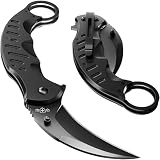
- Spring Assisted Karambit knife provides razor sharp cutting performance and high durability. Compact functional and stylish...
- Perfect tactical knife for everything - Camping, EDC, Hiking, Urban, Travel, Work, Self Defense, Bushcraft, Hunting, Fishing...
- Karambit knife features a handle ring for convenient forward and reverse grip. Lightweight and compact pocket CSGO karambit knife...
Best for: Compact tactical folding carry.
A 2.9-inch 440C stainless steel blade keeps this karambit compact enough for everyday carry while still offering a sharp, hard-use cutting edge. The spring-assisted opening and pocket clip make it quick to deploy and easy to keep on hand. For buyers who want a fighting-oriented folder instead of a fixed blade, that smaller footprint is the main advantage.
The aluminum handle helps keep total weight to 4.06 ounces, so it rides lightly in a pocket without feeling flimsy. At 7.6 inches overall, it opens into a usable karambit shape that offers better control than a flat utility folder. The 60 HRC hardness rating is the kind of detail that matters if you want edge retention from a small blade that may see frequent use. A liner lock adds a simple locking system, and the folding format makes it easier to carry in urban, travel, or EDC situations where a larger knife would be harder to manage.
Pros
- 2.9-inch 440C stainless blade balances sharpness and portability
- 60 HRC hardness supports edge retention
- 4.06-ounce weight keeps pocket carry light
- Spring-assisted opening and pocket clip improve access
Cons
- The 2.9-inch blade gives less reach than a full-size fixed fighting knife.
This is the pick for someone who wants a compact fighting-style knife that still feels purpose-driven. It is especially useful for EDC carry, quick access, and buyers who prefer a folding karambit over a fixed blade.
| Specification | Details |
|---|---|
| Blade Material | 440C stainless steel |
| Handle Material | Aluminum |
| Blade Length | 2.9 inch |
| Total Length | 7.6 inch |
| Weight | 4.06 oz |
| Lock Type | Liner lock |
| Special Feature | Spring Assisted, Pocket Clip, Folding, Karambit |
| Recommended Uses For Product | EDC, Camping, Self Defence |
| Style | Compact |
I’d favor this if pocket carry matters more than maximum reach. The spring assist, clip, and slim weight make it practical for daily carry, and the karambit shape gives it a more controlled feel than a straight utility folder. Buyers who want a discreet, fast-opening knife will appreciate how little space it takes.
3. Smith & Wesson 9″ H.R.T Double Edged Boot Knife with

- DIMENSIONS: 9 inch (22.9 centimeter) overall length with a blade length of 4.7 inches (12.1 centimeter) and a weight of 7.7 ounces
- DURABLE: Blade is made of reliable 7Cr17MoV high carbon stainless steel with a black rubber wrapped handle
- DEPENDABLE: Quick and easy access with the convenient belt or boot sheath making it ideal for everyday carry
Best for: Boot-carry double-edged option.
A 4.7-inch double-edged blade gives this Smith & Wesson boot knife a purpose-built profile for close carry and quick access. The 9-inch overall length and 7.7-ounce weight keep it compact enough for boot or belt placement. With a black rubber wrapped handle, it gives the user a secure grip in a small, carry-friendly package.
The 7Cr17MoV high carbon stainless steel blade is a practical choice for a knife that may spend time in a sheath and need to resist wear. The included belt or boot sheath matters because it lets the knife ride low and stay accessible without taking up pocket space. A hand guard is a useful defensive feature that helps keep the hand from sliding forward during forceful use. The lanyard hole adds another carry option, especially if you want neck carry or extra retention. Overall, the proportions make sense for buyers looking for a compact fighting knife rather than a general outdoor chopper.
Pros
- 4.7-inch double-edged blade suits close-carry use
- 7Cr17MoV stainless steel supports dependable wear resistance
- Boot or belt sheath improves access and carry options
- Hand guard adds grip security during forceful use
Cons
- The double-edged blade is less versatile for routine utility cutting than a plain-edge knife.
This boot knife fits buyers who want a compact, sheath-carry option with a fighting-first layout. It works best when discreet carry and fast access matter more than all-purpose utility.
| Specification | Details |
|---|---|
| Overall Length | 9 inch |
| Blade Length | 4.7 inches |
| Weight | 7.7 ounces |
| Blade Material | 7Cr17MoV high carbon stainless steel |
| Handle Material | Rubber |
| Included Components | 9″ H.R.T Double Edged Boot Knife |
| Color | Black |
| Style | Dual Edge (Box) |
| Recommended Uses For Product | Hunting |
I like this for users who want a compact boot knife with a real hand-guard and sheath carry. It feels better suited to defensive or emergency placement than to camp chores, and that is exactly its strength. If you want something small, accessible, and easy to stage on a belt or boot, this one makes sense.
4. Tactical Survival Knife with Sheath – 6.5″ Fixed Full Tang

- Black tactical survival knife for men with sheath, serrated blade and rubber ergonomic handle. Full tang knife is made of high...
- Razor Sharp Edge & Serrated Blade. Fixed blade knife has a sharp edge for precise slicing, partially serrated blade easily saws...
- Full Tang for Maximum Strength. The suvival knife with a full tang construction, where the blade runs through the entire handle...
Best for: Hard-use survival fixed blade.
A 440C stainless steel full tang gives this Grand Way knife the kind of structure buyers look for in a fighting or survival blade. The 11.65-inch overall length pairs with a 6.7-inch blade to provide a more substantial reach than compact carry knives. The rubber ergonomic handle helps keep control when the knife is used hard or wet.
The partially serrated blade is useful when a buyer wants both clean slicing and a saw-like section for rope or tough material. At 7 ounces, it stays light enough for belt carry while still feeling substantial in hand. The 4.95-inch handle gives room for a controlled grip, which matters when using a fixed blade in emergency or defensive situations. The non-reflective black oxide finish also reduces flash and wear visibility, which is useful for discreet outdoor use. Since a sheath is included, the knife is easier to carry securely during camping, hunting, or fighting-oriented use.
Pros
- 440C stainless full tang adds strength for hard use
- 6.7-inch blade gives useful reach
- Partially serrated edge cuts rope and tough material well
- 7-ounce weight keeps carry manageable with the included sheath
Cons
- The serrated section can make fine slicing less clean than a plain edge.
For buyers who want one fixed blade to cover survival, camp, and defensive use, this is a practical middle ground. Its mix of length, serration, and full-tang construction makes it a sensible belt knife for rougher conditions.
| Specification | Details |
|---|---|
| Material | 440C stainless steel |
| Overall Length | 11.65” |
| Blade Length | 6.7” |
| Handle Length | 4.95” |
| Weight | 7 oz |
| Handle Material | Rubber |
| Recommended Uses For Product | Bushcrafting, Camping, Emergency, Fighting, Hunting |
| Included Components | Sheath |
| Color | 1. Black |
I’d recommend this to someone who wants a more versatile fighting-oriented fixed blade with real outdoor utility. The serration and full tang make it useful beyond pure defense, and the rubber handle helps when conditions are messy. It is a good fit if you want one knife that can live on your belt and handle rough tasks too.
5. GLOCK FM 81 Field Knife 6.5″ Fixed Blade, Carbon Steel
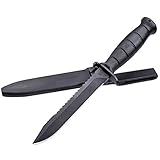
Best for: Classic field knife with saw.
A spring steel blade hardened to Hrc55 gives this GLOCK field knife a tougher edge profile than many casual camp knives. The 12-inch blade length and 6.5-inch fixed-blade format create a large, functional knife for fighting, hunting, and rough outdoor work. The black finish and fixed construction keep the design straightforward and purposeful.
The phosphate-treated blade is important for users who want a finish that helps the knife resist wear in the field. A sturdy saw on the blade adds another layer of utility for cutting wood or rough material, which is useful if the knife must handle more than defensive carry. Because the model is listed for camping, fighting, hiking, and hunting, it is aimed at buyers who want a multi-use field knife rather than a pure dagger. The black color also helps keep the look discreet, and the adult-sized build supports confident handling for larger tasks. For users who value a tool-like fighting knife, this one has a very practical profile.
Pros
- Spring steel blade hardened to Hrc55 supports edge toughness
- 12-inch blade length gives substantial reach
- Phosphate-treated finish helps resist wear
- Sturdy saw adds utility for field work
Cons
- The 12-inch blade length makes it bulkier to carry than shorter fighting knives.
This is a good match for buyers who want a large, utility-leaning fighting knife with a saw. It makes the most sense for field use, outdoor carry, and those who prefer a substantial fixed blade over a compact defensive piece.
| Specification | Details |
|---|---|
| Blade Material | Spring Steel Hrc55 Phosphate Treated |
| Blade Length | 12 inches |
| Special Feature | Sturdy Saw, Phosphate-Treated Blade |
| Recommended Uses For Product | Camping, Fighting, Hiking, Hunting |
| Color | Black |
| Style | oem |
| Model Name | KB17281 |
| Brand | GLOCK |
| Age Range (Description) | Adult |
I’d choose this if you want a larger field knife that can still pull double duty as a fighting tool. The saw and phosphate-treated blade make it more practical for rough use than many plain combat knives. Buyers who like a bigger knife with a straightforward, work-first feel will be happy with it.
6. KA-BAR EK44 Model 4 Commando Knife – 12.625″ Tactical Fixed

- Legendary WWII-Inspired Design – A modern tribute to the original John Ek Commando Knife, trusted by elite forces across...
- Rugged 1095 Cro-Van Steel Blade – High-carbon steel with parkerized finish for superior edge retention and corrosion resistance.
- Double-Edged Spear Point – Hand-ground 6.625" blade optimized for piercing and close-quarters combat.
Best for: Close-quarters commando pattern.
A 6.625-inch double-edged spear point on 1095 Cro-Van steel gives this KA-BAR a clear close-quarters orientation. The 12.625-inch overall length and full tang construction provide the size and structure expected from a tactical fixed blade. The parkerized finish and non-slip handle style make it a strong fit for buyers who want a serious fighting knife with modern materials.
The hand-ground blade is optimized for piercing, which is the key attribute that separates this model from utility-first camp knives. A full tang with extended pommel adds impact durability and gives the knife a more robust feel in tactical environments. The glass-filled nylon handle material is a practical choice for grip stability and weather resistance, especially compared with softer handle materials. Since the knife includes a sheath, carry and storage are straightforward for hunting or gear bag use. Buyers who want a historic pattern updated with stronger material choices will appreciate how the 1095 Cro-Van steel and parkerized finish work together.
Pros
- 1095 Cro-Van steel supports strong edge retention
- Double-edged spear point favors piercing use
- Full tang with extended pommel adds structural strength
- Sheath included for secure carry and storage
Cons
- The double-edged spear point is less suited to routine utility slicing than a straight-edged outdoor knife.
This model fits buyers who want a serious commando-style fighting knife with modern construction. It is best for those who value penetration-focused geometry and a full tang over general-purpose utility.
| Specification | Details |
|---|---|
| Overall Length | 12.625″ |
| Blade Length | 6.625″ |
| Blade Material | 1095 CRO-VAN |
| Handle Material | Plastic |
| Special Feature | Non Slip |
| Included Components | Knife, Sheath |
| Color | Black |
| Style | Modern |
| Recommended Uses For Product | Hunting |
I’d suggest this to someone who wants a true tactical profile rather than a camp knife wearing tactical clothes. The spear point, full tang, and extended pommel make it feel purpose-built for close-quarters work. If you want a blade with military lineage and a more aggressive geometry, this is the one to look at.
7. Sykes Fairbairn US Army Double-Edged V42 Military Best Dagger Knife

- Authentic Replica: This knife is a meticulously crafted replica of the iconic Sykes Fairbairn V42 double-edged dagger used by...
- Durable Construction: Featuring a 7-inch carbon steel blade and a 5-inch handle, this knife boasts an overall length of 12 inches...
- Historic Design: The 2nd pattern design stays true to the original, capturing the essence of this legendary military knife.
Best for: Historic double-edged replica.
A 7-inch carbon steel blade and 12-inch overall length give this V42 dagger the proportions buyers expect from a classic fighting knife. The 5-inch handle and double-edged pattern reinforce its military-style focus. For someone who wants a period-inspired knife with a fighting-first layout, the historical shape is the main draw.
The 2nd pattern design keeps the knife close to the original Sykes Fairbairn form, which matters if you want a replica that looks and carries like the wartime design. Carbon steel is a natural fit for a dagger-style blade because it can be shaped into a keen edge and historically appropriate finish. The genuine leather sheath adds to the traditional carry setup and makes the knife more complete as a presentation or field piece. Because the product is listed specifically for fighting, it is not trying to be a general camp multitool. The black steel color also reinforces the military styling and makes the blade visually consistent with the overall design.
Pros
- 7-inch carbon steel blade suits a fighting dagger profile
- 12-inch overall length adds reach
- 2nd pattern design preserves historic appearance
- Genuine leather sheath supports traditional carry
Cons
- The replica focus makes it less versatile than a modern utility knife for everyday tasks.
This is a strong pick for buyers who want the look and proportions of an iconic military dagger. It makes the most sense for collecting, display, or fighting-oriented carry where historical design matters.
| Specification | Details |
|---|---|
| Blade Length | 7-inch |
| Overall Length | 12 inches |
| Blade Material | Carbon Steel |
| Handle Material | Carbon Steel, Leather-Wood |
| Included Components | Sheath |
| Color | Black Steel |
| Style | American |
| Model Name | V42 |
| Special Feature | Non Slip |
| Recommended Uses For Product | Fighting |
I’d recommend this to anyone who cares as much about heritage as utility. The V42 shape, carbon steel blade, and leather sheath give it a very specific identity that fighting-knife buyers will recognize immediately. If you want a knife that feels historically grounded and visually distinctive, this one stands out in a good way.
8. KA-BAR #1213 Black Straight Edge Knife / Hard Sheath

- FULL TANG DESIGN: One-piece construction provides strength, balance, and reliable use
- STRAIGHT EDGE BLADE: Blade supports general cutting, outdoor, and utility tasks
- DURABLE BLACK BLADE: Coated finish helps reduce wear and corrosion
Best for: Traditional straight-edge fixed blade.
A full tang construction gives this KA-BAR #1213 a one-piece structure that supports balance and reliable use. The straight-edge carbon steel blade keeps the design simple and practical for buyers who want a fighting-utility knife that still handles general cutting tasks. The hard sheath adds secure storage for everyday carry and outdoor transport.
The black coated blade is useful because the finish helps reduce wear and corrosion, which is important on a knife that may live in a sheath for long periods. The TPR handle material adds grip comfort without overcomplicating the design, and the ergonomic shape helps with control during longer use. Because the knife is labeled for hunting, it fits buyers who want a field-capable fixed blade that still carries a combat-style profile. The straight edge is also easier to maintain than a serrated pattern, especially for users who prefer simple sharpening. A hard sheath is a practical inclusion because it protects the blade and makes carry more secure.
Pros
- Full tang construction supports balance and strength
- Straight-edge carbon steel blade is easy to maintain
- Black coated finish helps reduce wear and corrosion
- Hard sheath improves safe storage and carry
Cons
- The straight edge gives less rope-cutting utility than a serrated fighting knife.
This is a straightforward option for buyers who want a fighting-utility knife without extra complexity. It makes sense for users who value simple maintenance, secure sheath carry, and a classic fixed-blade profile.
| Specification | Details |
|---|---|
| Blade Material | Carbon Steel |
| Handle Material | Thermoplastic Rubber (TPR) |
| Color | Black |
| Included Components | Sheath |
| Special Feature | HARD SHEATH |
| Style | American |
| Model Name | Ka-Bar – Fighting-Utility Knife, Black – Straight Edge, Kydex Sheath |
| Recommended Uses For Product | Hunting |
| Age Range (Description) | Adult |
I’d steer someone here if they want a classic fixed blade with a cleaner, easier-to-maintain edge. The full tang and hard sheath make it practical for carry, while the straight edge keeps sharpening simple. It is a good fit for buyers who want one knife that can handle both field use and fighting-knife styling without fuss.
9. KA-BAR USMC Fighting Fixed Blade Knife 7″ Partially Serrated Clip
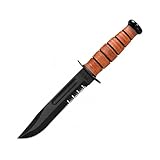
- Made in: USA
- Category name: knives
- Made in USA or imported
Best for: Iconic USMC combat classic.
A 7-inch partially serrated blade made from 1095 Cro-Van steel gives this USMC Ka-Bar the combination of reach and cutting versatility many fighting-knife buyers want. The 11 7/8-inch overall length and leather handle keep the knife faithful to its traditional combat pattern. Made in the USA, it also carries the appeal of a well-known military design.
The combo edge is the key feature here, because it lets the user handle slicing and tougher material with the same knife. The leather sheath helps the blade carry securely and stays in line with the classic military presentation. Since the model is listed for teens and adults, it has a broad user profile, but the size still favors people who want a full-size fixed blade. The lightweight designation matters for a knife with this much blade because it makes belt carry easier than heavier tactical models. For buyers who want the most recognizable Ka-Bar fighting shape with added serration, this version is a very logical choice.
Pros
- 1095 Cro-Van steel supports a proven combat-style blade
- 7-inch partially serrated edge adds cutting versatility
- 11 7/8-inch overall length provides full-size reach
- Leather handle and sheath keep the classic USMC feel
Cons
- The partially serrated edge is less straightforward to sharpen than a plain blade.
This is the pick for buyers who want the iconic USMC fighting knife with added serration. It suits belt carry, camp use, and anyone who values a classic military layout with practical edge variety.
| Specification | Details |
|---|---|
| Blade Length | 7″ |
| Overall Length | 11 7/8 in. |
| Blade Material | 1095 Cro-Van steel |
| Handle Material | Leather |
| Included Components | Sheath |
| Special Feature | Lightweight |
| Recommended Uses For Product | Camping |
| Color | Black |
| Style | American |
| Age Range (Description) | Teens and Adults |
I’d recommend this to anyone who wants the classic Ka-Bar look with a little more cutting versatility from the serrated section. The overall size feels right for a serious fixed blade, and the leather handle keeps it true to the original style. If you want a recognizable fighting knife that also remains useful outdoors, this is a strong option.
10. Dispatch Tactical Fixed Blade Knife, 5cr15mov Steel Blade G10 Handle,

- PREMIUM 5Cr15Mov STEEL BLADE: 5Cr15Mov Steel is tried-and-true performance steel. This blade has been tested in various...
- EXQUISITE G10 HANDLE: The ergonomic Solid G10 handle provide a durable, sure grip and increase concealability and...
- PRODUCT PARAMETER: Overall length: 7.08", blade length: 3.75", blade thickness: 0.197"(5mm), handle Length: 4.44", handle...

Best for: Ergonomic modern karambit.
A 5Cr15Mov steel blade hardened to 55-58 HRC gives this Dispatch knife a practical balance of toughness and edge-holding for fighting, utility, and EDC. The G10 handle with fiberglass and resin construction adds grip security, while the full tang format supports hard-use control. For buyers who want a modern karambit with carry tools included, the layout is especially useful.
The belt clip, holster, and sheath make this knife more carry-ready than many fixed blades because the accessories are already part of the package. Its recommended use list spans camping, emergency, fighting, fishing, hiking, martial arts, and utility, so it clearly targets buyers who want one knife for many roles. The serrated feature adds extra bite for rope or tougher material, and the non-slip design helps in active use. Because the blade is listed as stainless steel, the knife is easier to keep in rotation across different environments. The American style and black karambit color give it a modern tactical appearance without losing portability.
Pros
- 5Cr15Mov steel at 55-58 HRC supports practical edge performance
- G10 handle improves grip security across environments
- Full tang construction adds strength for hard use
- Belt clip, holster, and sheath improve carry options
Cons
- The karambit shape is specialized, so it is less versatile than a straight fixed blade for general slicing.
This one fits buyers who want a tactical karambit with useful carry gear included. It makes the most sense for EDC, martial arts, and emergency carry where grip and access matter more than general utility.
| Specification | Details |
|---|---|
| Blade Material | Stainless Steel |
| Handle Material | Fiberglass, Resin |
| Included Components | Belt Clip, Holster, Sheath |
| Color | Black Karambit Knife |
| Style | American |
| Age Range (Description) | Adult |
| Recommended Uses For Product | Camping, Carving, Emergency, Fighting, Fishing, Hiking, Martial Arts, Utility |
| Model Name | Karambit Knife |
| Brand | Dispatch |
I’d point buyers to this if they want a karambit with more carry flexibility than a bare fixed blade. The included clip, holster, and sheath make it easy to stage, and the handle material should appeal to anyone who wants a secure grip. It is a good fit for tactical-minded users who also want broader everyday utility.
Quick Comparison Table of Best Fighting Knives
| Product Name | Blade Type | Blade Material | Length | Best For | Check Price |
|---|---|---|---|---|---|
| KA-BAR Full Size US Marine Corps | Straight edge | 1095 carbon steel | 11.875 in | Close combat | Check Price |
| Tactical Spring Assisted Pocket Knife | Karambit folding | 440C stainless steel | 2.9 in | Self defence | Check Price |
| Smith & Wesson 9″ H.R.T Double | Double edged | 7Cr17MoV stainless | 4.7 in | Boot carry | Check Price |
| Tactical Survival Knife with Sheath | Fixed serrated | 440C stainless steel | 6.7 in | Fighting | Check Price |
| GLOCK FM 81 Field Knife 6.5″ | Fixed blade | Spring steel | 6.5 in | Camping fights | Check Price |
| KA-BAR EK44 Model 4 Commando Knife | Double-edged spear | 1095 Cro-Van | 6.625 in | Close quarters | Check Price |
| Sykes Fairbairn US Army Double-Edged V42 | Double-edged dagger | Carbon steel | 7 in | Fighting | Check Price |
| KA-BAR #1213 Black Straight Edge Knife | Straight edge | Carbon steel | Unknown | Utility work | Check Price |
| KA-BAR USMC Fighting Fixed Blade Knife | Partially serrated | 1095 Cro-Van steel | 7 in | Camping | Check Price |
| Dispatch Tactical Fixed Blade Knife, 5cr15mov | Karambit fixed | 5Cr15Mov steel | Unknown | Martial arts | Check Price |
How to Choose the Best Knife for Fighting
Blade length and balance
Choose a blade length that matches tight movement and fast indexing, not maximum reach. For a fighting knife, a blade around 3 to 5 inches gives the best mix of control, concealability, and point management in close quarters; longer blades add reach but slow transitions and crowd the hand under stress. Look for a balanced knife with the pivot point near the guard or slightly forward, not a nose-heavy tip that drags on every cut.
The best pick for most buyers is a compact 3.5- to 4.5-inch blade with neutral balance for quicker control and cleaner handling.
Steel quality and edge retention
Steel choice comes down to how hard you want to work on maintenance versus edge life. High-carbon steels hold a sharp edge longer under repeated use and are easier to touch up quickly, while stainless steels resist rust better and suit wet carry or humid climates. Good edge retention shows up in steels that stay keen after repeated slicing and still sharpen without dragging; poor picks roll or dull fast.
For most buyers, choose a corrosion-resistant stainless blade for low-maintenance carry, or a high-carbon blade if you value the longest, easiest-to-refresh edge.
Handle grip and ergonomics
Pick a handle that locks the knife in place when your hands are wet, tired, or gloved. Textured G10, Micarta, rubberized overmolds, or deeply scalloped synthetic scales give a secure grip; smooth polished handles slip under pressure and make the knife feel loose in the hand. A proper guard or pronounced finger choil helps stop the hand from sliding onto the edge, and the best shapes let you index the blade fast without hot spots.
For most buyers, a textured synthetic handle with a modest guard is the safest, most controlled choice.
| Handle type | Best for |
|---|---|
| G10 or Micarta scales | Secure grip and all-around control |
| Rubberized handle | Wet conditions and glove use |
| Smooth metal handle | Only when paired with deep texture or strong finger grooves |
Strength, construction, and durability
Strength starts with full-tang construction, where the steel runs through the entire handle for the best resistance to torque, impact, and rough handling. Partial-tang knives feel lighter, but they have less margin under hard use and are easier to crack at the handle junction. Check the spine thickness too: a blade around 3/16 inch offers a strong mix of rigidity and control, while very thin spines flex more and very thick ones sacrifice precision.
For most buyers, a full-tang knife with a medium-thick spine is the right choice for dependable durability.
| Construction | Best for |
|---|---|
| Full tang | Maximum durability and hard use |
| Partial tang | Lighter carry and less demanding use |
| Thick spine | Prising resistance and impact strength |
| Medium spine | Balanced rigidity and handling |
Carry method and deployment speed
Carry matters because the best knife is the one you can access cleanly and keep secure. Choose a sheath with firm retention, a positive lock, and no wobble; the blade should stay put during movement and release with a straight, unobstructed draw. Belt carry offers the fastest access, pack carry adds discretion, and vest or chest carry gives faster access when seated or burdened.
A smooth draw path with a thumb ramp or molded throat is a strong sign of good retention without drag. For most buyers, a retention-secure belt sheath with flexible mounting is the smartest choice for speed and control.
| Carry method | Best for |
|---|---|
| Belt sheath | Fastest everyday access |
| Pack carry | Discreet transport and backup storage |
| Chest or vest carry | Quick access with heavy gear or seated use |
Which Should You Choose?
- If you want a proven full-size fixed blade with classic fighting-knife handling, choose a straight-edge blade around 7 inches with a leather sheath and full-tang construction.
- If you need something compact for pocket carry or quick access, choose a folding knife with a spring-assisted opening and a curved karambit-style blade.
- If you want a boot-carry option for close-quarters use and concealment, choose a double-edged blade under 5 inches with a narrow profile and a sturdy sheath.
- If you want a tough utility-first blade that can still handle defensive tasks, choose a full-tang fixed blade with a 6.5- to 6.7-inch blade, a textured grip, and a serrated edge.
Quick Best Knife For Fighting Buying Checklist
- Choose a blade length that balances reach with control. A shorter, manageable blade is often easier to handle in tight spaces.
- Look for strong steel with solid edge retention. The blade should stay sharp and resist wear after repeated use.
- Prioritize a secure, non-slip handle. A textured grip helps maintain control during quick movements and wet conditions.
- Check for a full-tang construction. This usually adds strength, stability, and better long-term durability.
- Inspect the sheath or carry system. Reliable retention and fast access matter when speed and security are both important.
- Make sure the knife feels balanced in hand. Proper weight distribution improves accuracy, control, and confidence.
Blade Geometry and How It Affects Use
Blade geometry has a major effect on how a knife behaves in close-quarters use. A full tang, rigid spine, and balanced weight help a knife stay stable under stress, while blade shape influences reach, penetration, and control. Straight-edged blades tend to offer predictable contact and easier maintenance, while some curved profiles can improve slicing motion.
Thickness also matters: a thicker blade is generally stronger but may feel slower in hand, while a slimmer blade can move more quickly but may be less durable in hard use.
| Geometry | Strength | Trade-off |
|---|---|---|
| Drop point | Versatile and controlled | Less specialized for thrusting |
| Clip point | Fine tip access | Tip can be more delicate |
| Straight spine | Simple, robust structure | Less specialized cutting curve |
| Thicker stock | Improved rigidity | Reduced agility |
Fixed Blade vs Folding Knife in Close-Quarters Use
Fixed blades and folding knives serve very different roles in combat-oriented discussions. A fixed blade is mechanically simpler because it has no moving parts, which can make it more dependable under impact, twisting, or repeated stress. Folding knives are more compact and easier to carry discreetly, but their locking mechanisms add a layer of complexity and can become a weak point if the knife is used aggressively.
In practical terms, the best fighting knife format is often the one that remains secure in hand and ready without delay. Handle length, lock strength, and opening speed all influence how the knife performs in a high-pressure situation.
| Type | Primary Advantage | Main Limitation |
|---|---|---|
| Fixed blade | Maximum reliability | Less compact for carry |
| Liner lock folder | Convenient carry | Lock can be stressed |
| Frame lock folder | Stronger lockup | Heavier in the handle |
| Auto or assisted folder | Fast deployment | Mechanism adds complexity |
Materials That Influence Durability and Corrosion Resistance
Knife materials affect edge retention, toughness, and how well the blade resists rust. Stainless steels are popular because they handle moisture better and require less frequent upkeep, while high-carbon steels can be easier to sharpen and may offer excellent cutting performance with proper care. Handle materials matter too: textured polymers, G-10, micarta, and similar composites often provide secure grip in wet conditions.
Metal handles can be very strong, but they may feel slick unless shaped carefully. The right material combination depends on the environment, expected maintenance, and whether the knife is intended for harsh field use or regular carry.
| Material | Main Benefit | Main Care Need |
|---|---|---|
| Stainless steel blade | Better corrosion resistance | Still needs drying and cleaning |
| High-carbon steel blade | Easy sharpening, strong edge | Oiling to prevent rust |
| G-10 handle | Excellent grip | Minimal maintenance |
| Micarta handle | Comfort and traction | Occasional cleaning |
Safe Handling Habits That Reduce Risk
Any knife used in a defensive context carries serious safety risks, especially during training or carry. The safest habits start with a secure grip, controlled movement, and awareness of where the edge points at all times. A sheath or lock should fully retain the knife during movement so it cannot shift unexpectedly.
Users should also practice drawing and re-sheathing slowly before increasing speed, since many injuries happen when attention drops during transitions. Even a well-built knife can be hazardous if handled while distracted, fatigued, or under poor lighting.
Careful storage and consistent habits are as important as the knife itself.
- Keep the edge oriented away from the body during handling.
- Use a sheath or lock that fully secures the blade.
- Inspect the knife before and after practice.
- Store it separately from children and unauthorized users.
- Re-sheath only when your hand is stable and focused.
Legal and Ethical Considerations Before Carrying
Knife laws vary widely by location, and a blade that is legal in one place may be restricted in another. Rules can involve blade length, opening mechanism, concealed carry, or whether the knife is classified as a weapon. Ethical use matters just as much: a knife should never be viewed as a substitute for de-escalation, escape, or calling for help.
If a knife is carried for lawful self-defense, the carrier should understand local regulations, the responsibilities that come with concealed carry, and the risks of escalation. Training in awareness and avoidance is often more valuable than focusing only on the blade itself, because the best outcome is always to avoid a physical confrontation when possible.
| Consideration | Why It Matters | Action |
|---|---|---|
| Local law | Defines what can be carried | Check current statutes |
| Carry method | Can affect legality and access | Review concealed carry rules |
| Training | Reduces unsafe assumptions | Practice lawful, defensive habits |
| Ethics | Encourages restraint | Prioritize avoidance and escape |
Frequently Asked Questions (FAQs)
What Blade Length Works Best For A Fighting Knife?
The best blade length for a fighting knife is one that gives enough reach without sacrificing control. A medium-length blade often handles faster in close quarters while still offering usable distance, and it is easier to index, draw, and steer accurately under pressure.
Why Does Full-Tang Construction Matter In A Fighting Knife?
Full-tang construction matters in a fighting knife because it usually provides stronger, more reliable structural support. The blade and handle are built as one continuous piece, which helps reduce weak points, improve durability, and keep the knife stable during hard use.
What Handle Features Improve Control On A Fighting Knife?
A fighting knife handle should offer a secure grip, a clear guard, and a shape that fills the hand comfortably. Texturing or contouring helps prevent slipping, while a defined finger stop can improve retention when the hand is moving quickly or sweating.
Which Steel Traits Are Most Important In A Fighting Knife?
A fighting knife should use steel that balances edge retention, toughness, and corrosion resistance. Good steel holds a usable edge through repeated contact, but it also needs enough resilience to resist chipping or bending when the knife is used aggressively.
How Important Is Balance In A Fighting Knife?
Balance is very important in a fighting knife because it affects speed, point control, and fatigue. A well-balanced knife feels predictable in the hand, allowing quicker transitions and more precise handling than a model that feels overly blade-heavy or handle-heavy.
What Sheath Features Should I Look For In A Fighting Knife?
A fighting knife sheath should hold the blade securely while still allowing a smooth, consistent draw. Strong retention, reliable attachment options, and low-friction access matter because the sheath must protect the edge, prevent accidental release, and keep the knife ready when needed.
How Do I Choose A Fighting Knife For Everyday Carry?
An everyday-carry fighting knife should be compact, discreet, and easy to access without snagging. Look for a design that rides securely, draws cleanly, and stays comfortable during normal movement, because practical carry matters as much as the blade’s physical specifications.
Final Suggestions
In summary, the best knife for fighting combines dependable steel, secure handling, solid construction, and fast access in one focused design. Those qualities make it a practical tool for users who value control, durability, and readiness in demanding situations. Choose carefully, compare the details, and you can find a knife that inspires confidence when it matters most.