Top 10 Best Rated Tankless Gas Hot Water Heater
The best rated tankless gas hot water heater stands at the intersection of efficiency, comfort, and modern heating technology. Unlike bulky storage tanks, these compact units heat water on demand, helping reduce standby energy loss while supporting consistent flow for showers, sinks, and high-demand household routines. As gas tankless water heaters continue to advance, shoppers must weigh BTU output, flow rate, venting requirements, and heat exchanger materials that affect durability and performance.
The right tankless gas water heater can also improve space savings and long-term operating costs, but not every model handles peak demand the same way. In this guide, the best rated tankless gas hot water heater options are examined through the details that matter most, so the differences become clear before you choose the system that fits your home.
Detailed Reviews of the Best Rated Tankless Gas Hot Water Heater
1. Rheem RTG Series 7.0 GPM Natural Gas Tankless Water Heater

- High Performance Natural Gas Tankless Water Heater delivers endless instant hot water on demand for whole house residential use...
- Energy Efficient Non-Condensing Gas Tankless Water Heater with 0.82 Uniform Energy Factor (UEF) saves up to 34% on energy costs...
- Ideal Whole House Tankless Gas Water Heater for large families and multi-bathroom homes with 2-3 water points running...

Best for: Whole-home natural gas power.
A 13.5-inch-wide cabinet keeps the Rheem RTG Series compact enough for indoor mechanical spaces while still delivering whole-house hot water. That smaller footprint helps it fit where bulkier tank heaters would crowd storage, yet it can support simultaneous showers without the recovery lag of a storage tank. The natural gas setup and direct vent design make it a practical swap for homes seeking steady, on-demand hot water.
The 7.0 GPM flow rate at a 35°F temperature rise gives this heater enough output for 2 to 3 simultaneous showers, which is the real advantage in a busy household. Its 160,000 BTU/hr rating adds the heating muscle needed for repeated hot-water use across bathrooms and sinks. The 0.82 Uniform Energy Factor points to efficient operation, and the integrated digital display makes temperature checks straightforward at a glance. Hot-start programming helps reduce cold-water surprises at the tap, while 1/2 gas line compatibility can simplify planning during installation. Indoor direct venting keeps the system suited to enclosed utility spaces.
Pros
- 7.0 GPM supports 2 to 3 showers at once
- 160,000 BTU/hr output handles whole-house demand
- 0.82 UEF improves heating efficiency
- Integrated digital display and hot-start programming add control
Cons
- Indoor direct vent installation requires the right venting setup, so it is not a simple outdoor drop-in unit.
Rheem’s RTG Series makes sense for homes that want dependable whole-house hot water from a compact natural gas unit. It fits best where indoor installation and steady multi-fixture use matter most.
| Specification | Details |
|---|---|
| Brand | Rheem |
| Capacity | 7 gallons |
| Power Source | Natural Gas |
| Product Dimensions | 13.5″W x 24.2″H |
| Flow Rate | 7.0 GPM |
| BTU Output | 160,000 BTU/hr |
| Uniform Energy Factor | 0.82 UEF |
| Installation | Indoor |
| Vent System | Direct vent |
I’d point buyers here if they want a compact natural gas heater that can actually keep up with family routines. The combination of 7.0 GPM, 160,000 BTU/hr, and indoor direct venting makes it a strong fit for homes replacing a tank with a more responsive system. It is especially appealing if you value straightforward temperature visibility and efficient operation.
2. Rinnai RX199iN Condensing Smart Sense Tankless Water Heater

- One Model, Anywhere: This Rinnai tankless water heater is installable indoors or outdoors thanks to our new Versa Vent and powered...
- Never Run Out of Hot Water with this Compact Tankless Gas Water Heater: This condensing propane and natural gas tankless water...
- Smart, Efficient Design: This water heater's modern design includes an easy-to-use interface, Quick Flush feature for simplified...
Best for: Flexible indoor-or-outdoor install.
An 18.5-inch-wide chassis gives the Rinnai RX199iN a compact footprint for a unit that can serve up to 11.1 GPM. That matters when you need one heater to cover a busy house without giving up storage or utility space. Its ability to run indoors or outdoors expands placement options, and the gas flexibility supports either propane or natural gas.
The 11.1 GPM capacity is the headline here, because it can support up to 7 fixtures at once for larger households or homes with heavy simultaneous use. The condensing design helps extract more heat from the fuel, and the Smart Sense gas control system lets the unit work with either propane or natural gas. Versa Vent adds install flexibility, which is valuable when indoor clearance or exterior placement changes the plan. At 30.11 inches tall, it still stays relatively compact for the output level, making it easier to place in a tight mechanical area or on an exterior wall.
Pros
- 11.1 GPM supports up to 7 fixtures at once
- Works with propane or natural gas
- Versa Vent expands installation options
- Compact 18.5-inch width helps in tight spaces
Cons
- Outdoor installation requires the RX-OVC vent cap, so the full setup is not complete out of the box for exterior use.
This Rinnai fits buyers who need high-capacity hot water with real installation flexibility. It is a strong choice for larger homes, especially when the location may need to shift between indoor and outdoor mounting.
| Specification | Details |
|---|---|
| Brand | Rinnai |
| Capacity | 11.1 gallons |
| Power Source | Gas Powered |
| Product Dimensions | 18.5″W x 30.11″H |
| Flow Rate | 11.1 GPM |
| Special Features | Smart Sense gas control system, Versa Vent |
| Installation | Indoor or Outdoor |
| Fuel Options | Propane or Natural Gas |
My take is that this is the one to shortlist if your hot-water demand is high and you want installation flexibility. The 11.1 GPM rating is the big draw, but the indoor-outdoor option is what makes it especially useful for tricky layouts. It suits households that want one system covering many fixtures without committing to a single installation location.
3. Rheem RTG Series 7.0 GPM Liquid Propane Tankless Water Heater

- High Performance Liquid Propane Tankless Water Heater delivers endless instant hot water on demand for whole house residential use...
- Energy Efficient Non-Condensing Gas Tankless Water Heater with 0.82 Uniform Energy Factor (UEF) saves up to 34% on energy costs...
- Ideal Whole House Tankless Gas Water Heater for large families and multi-bathroom homes designed for outdoor installation, this...
Best for: Outdoor propane for smaller spaces.
A 13.5-inch-wide body keeps the Rheem RTG Series propane model compact while still delivering whole-house hot water outdoors. That compact shape helps it tuck along an exterior wall without dominating the space, and the outdoor setup removes the need for venting. For propane users, the result is a practical high-output heater that fits smaller mounting areas better than a storage tank.
This unit matches the 7.0 GPM output of the series, which means it can handle 2 to 3 simultaneous showers at a 35°F temperature rise. The 160,000 BTU/hr rating shows why it can keep up with repeated household demand, while the 0.82 UEF supports efficient operation over time. Outdoor installation is a major practical advantage because it eliminates venting work, and 1/2 gas line compatibility can make the planning phase simpler. The 20.75-inch height keeps the cabinet manageable for exterior placement, and hot-start programming helps reduce the chance of cold bursts at the tap.
Pros
- 7.0 GPM supports whole-house propane use
- 160,000 BTU/hr output handles multiple showers
- Outdoor installation eliminates venting
- Hot-start programming helps reduce cold-water delay
Cons
- Outdoor-only installation means it cannot be placed inside a utility room or basement.
This Rheem is a smart fit for propane households that want a high-output outdoor unit. It works especially well when venting space is limited and you want dependable water delivery for several fixtures at once.
| Specification | Details |
|---|---|
| Brand | Rheem |
| Capacity | 7 gallons |
| Power Source | ac_dc |
| Product Dimensions | 13.5″W x 20.75″H |
| Flow Rate | 7.0 GPM |
| BTU Output | 160,000 BTU/hr |
| Uniform Energy Factor | 0.82 UEF |
| Installation | Outdoor |
I like this option for propane buyers who want a clean exterior install and enough capacity for a family home. The outdoor setup is the key advantage because it avoids venting entirely. It makes most sense if you want strong flow, simple placement, and a heater that won’t take up indoor utility space.
4. Propane Gas Tankless Water Heater Up to 4.3 GPM 100,000

- 【Note 】 This 4.3GPM propane gas model. Gas rated pressure: 11.24" w.c. (2.8 kPa), Gas Inlet & Cold Water Inlet & Hot Water...
- 【Reliable Hot Water on Demand】 With 100,000 BTU power, this on demand water heater delivers up to 4.3 GPM instant hot water...
- 【Precise Temperature Control】 Enjoy consistent water temperature with a wide adjustable range from 95°F to 149°F...
Best for: 4.3 GPM safety-first propane.
A 13.78-inch-wide housing gives the NOVIEEX propane heater a compact profile for smaller installation areas while still supporting on-demand hot water. That compact size helps it fit utility zones where a larger unit would be awkward, and the 110V-120V AC power requirement keeps the control system straightforward. For homes needing a propane unit with built-in safety features, this one focuses on controlled delivery.
The 4.3 GPM output and 100,000 BTU power rating position this model for moderate household use, such as one shower plus kitchen or bath fixtures at the same time. Its gas-rated pressure of 11.24 inches w.c. and 1/2-inch NPT gas and water connections give clear installation targets. The 1.5-116 psi water pressure range adds flexibility for different plumbing conditions, and the LED display helps with temperature monitoring. Anti-freezing, dry combustion, flame failure, and overheat protection work together to reduce risk during everyday operation, which is especially useful in colder areas or seasonal properties.
Pros
- 4.3 GPM suits moderate simultaneous use
- 100,000 BTU power supports instant heating
- LED display makes temperature monitoring easy
- Multiple protections add operational safety
Cons
- The 4.3 GPM output is better for moderate demand than for running several showers at once.
This NOVIEEX model is best for propane buyers who want compact size and layered safety features. It makes the most sense in smaller homes or cabins where moderate hot-water demand is the norm.
| Specification | Details |
|---|---|
| Brand | NOVIEEX |
| Capacity | 16000 milliliters_per_minute |
| Power Source | Propane Gas |
| Product Dimensions | 13.78″W x 23.23″H |
| Flow Rate | 4.3 GPM |
| BTU Output | 100,000 BTU |
| Water Pressure Range | 1.5-116 psi (0.01-0.8MPa) |
| Power Supply | 110V-120V AC/60Hz |
| Special Features | Anti-Freezing Protection, Dry Combustion Protection, Flame Failure Protection, LED Display, Overheat Protection |
I’d steer someone to this if they want a propane heater with explicit protection features and a straightforward installation profile. It is not the biggest-capacity option, but the 4.3 GPM flow and safety suite make it practical for smaller homes or point-heavy but not heavily simultaneous use. The LED display is a helpful everyday touch.
5. ThermoMate CZ422NG, Natural Gas Tankless Water Heater Indoor, Up to

- [Max 5 GPM & 102,000 BTU] – The ThermoMate instant water heater delivers hot water on-demand for two showers at the same time...
- [Safety & Reliable] - Certified by CSA, this residential gas water heater features boil-dry, freeze, flame-out, overheat, over...
- [Energy Efficient & Save Money] – Built with an oxygen-free copper heat exchanger for efficient heat transfer and corrosion...
Best for: Stable natural gas for two showers.
A 13.77-inch-wide cabinet gives the ThermoMate CZ422NG a compact indoor footprint for a natural gas heater rated at up to 5 GPM. That size makes it easier to place in a utility area without crowding the room, while the 113,000 BTU rating supports steady hot water for a busy household. Its control system is aimed at consistency rather than guesswork.
The 5 GPM output is enough for two showers at the same time, and the unit is tuned to hold a stable 105°F based on a 65°F inlet temperature. The smart flow sensor and control chip adjust heating 20,000 times per second, which helps keep temperature swings small at the tap. The CSA certification matters for buyers who want a listed residential unit, and the integrated error code indicator gives quicker troubleshooting feedback. Anti-freezing, dry combustion, flame failure, and high water pressure protection round out the safety package, making it a practical fit for homes that want a predictable indoor gas heater.
Pros
- 5 GPM supports two showers at once
- 113,000 BTU rating handles residential demand
- ±1°F temperature consistency helps steady output
- Integrated error code indicator simplifies troubleshooting
Cons
- Indoor installation limits it to enclosed utility spaces rather than exterior mounting.
ThermoMate fits buyers who want a dependable indoor natural gas heater with tight temperature control. It is especially appealing for households that care about consistency and clear safety feedback more than maximum flow.
| Specification | Details |
|---|---|
| Brand | thermomate |
| Capacity | 5 gallons |
| Power Source | Natural Gas |
| Product Dimensions | 13.77″W x 21.65″H |
| Flow Rate | 5 GPM |
| BTU Output | 113,000 BTU |
| Temperature Stability | ±1°F |
| Installation | Indoor |
I think this is a good match for homeowners who want consistent showers without a complicated control experience. The 5 GPM output is enough for common family use, and the error code indicator adds practical value when something needs attention. It feels best suited to people who prioritize steady temperature over chasing the largest possible flow rate.
6. APUS Natural Gas Tankless Water Heater, 95,000 BTU, 4.42 GPM
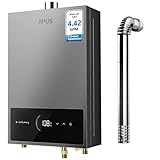
- 𝐏𝐨𝐰𝐞𝐫𝐟𝐮𝐥 & 𝐇𝐢𝐠𝐡-𝐂𝐚𝐩𝐚𝐜𝐢𝐭𝐲: This high-performance tankless water heater...
- 𝐏𝐫𝐞𝐜𝐢𝐬𝐞 & 𝐒𝐭𝐞𝐚𝐝𝐲: With high-precision sensors and smart CPU technology, this tankless water...
- 𝐄𝐟𝐟𝐢𝐜𝐢𝐞𝐧𝐭 & 𝐃𝐮𝐫𝐚𝐛𝐥𝐞: Featuring oxygen-free copper heat exchangers and innovative...
Best for: Compact high-flow natural gas unit.
A 5.9-inch-wide body makes the APUS heater unusually slim for a natural gas tankless model, which helps it slide into narrow utility spaces. That narrow profile pairs with a 4.42 GPM flow rate, so the unit can serve multiple fixtures without taking much wall space. For buyers balancing compact installation with useful household output, that combination is the main draw.
The 95,000 BTU heating capacity gives the APUS enough output for 2 showers plus 1 sink during peak use, which is a useful middle ground for smaller families. Its 0.66 GPM low-flow start technology helps the unit respond when demand begins at modest flow levels, reducing dead spots in typical daily use. High-precision sensors and smart CPU control are aimed at steady temperature management, and the anti-freezing, low water flow, and overheat protections add peace of mind. Easy installation and 24/7 customer service are listed features, but the hardware story is really about compact size and practical flow handling in tight spaces.
Pros
- 5.9-inch width fits narrow spaces
- 4.42 GPM supports 2 showers plus 1 sink
- 95,000 BTU output suits smaller households
- Low-flow start technology improves low-demand response
Cons
- The 4.42 GPM flow is less suited to large homes that need several showers running at once.
APUS is a strong fit for buyers who need a slim natural gas heater with enough output for everyday family use. It works best where wall space is tight and the hot-water load is moderate rather than very heavy.
| Specification | Details |
|---|---|
| Brand | APUS |
| Capacity | 4.42 gallons |
| Power Source | Natural Gas |
| Product Dimensions | 5.9″W x 20.55″H |
| Flow Rate | 4.42 GPM |
| BTU Output | 95,000 BTU |
My advice is to consider this if your priority is saving wall space without dropping into a tiny, underpowered heater. The slim width is the standout practical feature, but the 4.42 GPM output still gives it enough usefulness for a normal household routine. It is a sensible choice for moderate demand and tighter utility areas.
7. MIZUDO 120,000 BTU Natural Gas Tankless Water Heater,Max 5.1 GPM,WiFi&APP
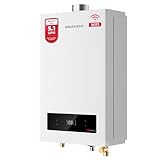
- [Flexible Indoor&Outdoor Installation Solution]: Mizudo innovative natural gas tankless water heater indoor offers versatile...
- [Smart WiFi and App Control]: Manage your tankless water heater gas remotely through the dedicated mobile application. Adjust...
- [Advanced Temp Control]: The tankless gas water heater combines sophisticated water flow monitoring and gas modulation to maintain...
Best for: Smart control for flexible installs.
A 14.56-inch-wide cabinet keeps the MIZUDO heater compact enough for either indoor or outdoor conversion with the right accessory kits. That flexibility lets buyers adapt the installation to the home layout instead of forcing the layout around the heater. With WiFi and app control built in, it also gives you remote temperature management without opening the unit or going to the basement.
The 5.1 GPM flow rate and 120,000 BTU rating give this unit enough capacity for 2 to 4 usage points, which makes it a practical whole-home fit for medium-demand households. Its indoor-and-outdoor convertible installation is a major planning advantage, especially where space changes or climate conditions matter. The WiFi and app control features let you monitor and adjust settings remotely, while the CSA certification adds a useful compliance signal. Anti-freezing protection helps in colder climates, and the listed support for 2 to 4 usage points tells you the output is aimed at normal family routines rather than maximum-demand homes.
Pros
- 5.1 GPM supports 2 to 4 usage points
- Indoor and outdoor convertible installation adds flexibility
- WiFi and app control simplify remote adjustments
- 120,000 BTU output suits medium household demand
Cons
- Outdoor conversion requires accessory kits, so the installation is not fully plug-and-play for exterior use.
MIZUDO is a good match for buyers who want smart controls and flexible placement in one package. It is especially useful for homes where the final installation location may change with the layout or climate.
| Specification | Details |
|---|---|
| Brand | MIZUDO |
| Capacity | 5.1 gallons |
| Power Source | Natural Gas |
| Product Dimensions | 14.56″W x 22.83″H |
| Flow Rate | 5.1 GPM |
| BTU Output | 120,000 BTU |
| Special Features | Anti-Freezing Protection, CSA Certified, Indoor&Outdoor Convertible Installation, Supporting 2 to 4 usage points, WiFi&APP Control |
| Installation | Indoor & Outdoor Convertible |
I’d recommend this to shoppers who want a flexible install and remote control in the same heater. The smart app features are genuinely useful if you like adjusting settings without going to the unit, and the 5.1 GPM output is enough for a medium-sized household. It is a practical balance of convenience and capacity.
8. Natural Gas Tankless Water Heater Up to 4.3 GPM 100,000

- 【Note 】 This is 4.3GPM natural gas model. Gas rated pressure: 8.04" w.c. (2.0 kPa), Gas Inlet & Cold Water Inlet & Hot Water...
- 【Reliable Hot Water on Demand】 With 100,000 BTU power, this on demand water heater delivers up to 4.3 GPM instant hot water...
- 【Precise Temperature Control】 Enjoy consistent water temperature with a wide adjustable range from 95°F to 149°F...
Best for: Natural gas with compact safety features.
A pearl gray finish gives the NOVIEEX natural gas model a clean, neutral look, while the 4.23-gallon capacity keeps the unit compact for modest household demand. That size makes it easier to place in tighter utility spaces, and the natural gas setup keeps the installation aligned with common home fuel systems. Its safety features are the main selling point for cautious buyers.
The 4.3 GPM output and 100,000 BTU power rating put this unit in the same practical range as other moderate-demand heaters, enough for a shower and a couple of fixtures at once. Gas rated pressure is listed at 8.04 inches w.c. and the unit uses 1/2-inch NPT connections for gas, cold water, and hot water, which clarifies what the install requires. The 110V-120V AC/60Hz power supply supports the control system, while the 1.5-116 psi water pressure range broadens compatibility. Anti-freezing, dry combustion, flame failure, LED display, and overheat protection make the model appealing for buyers who value visible status and built-in safeguards.
Pros
- 4.3 GPM covers moderate simultaneous use
- 100,000 BTU supports fast hot-water delivery
- Pearl grey finish offers a neutral look
- Multiple protection features improve everyday safety
Cons
- The 4.3 GPM capacity is not ideal for homes that need several showers running at the same time.
This NOVIEEX heater works well for buyers who want compact natural gas performance with a clean finish and clear protection features. It is best suited to smaller or moderate-use homes that do not need very high simultaneous flow.
| Specification | Details |
|---|---|
| Brand | NOVIEEX |
| Capacity | 4.23 gallons |
| Power Source | Natural Gas |
| Color | Pearl Grey |
| Flow Rate | 4.3 GPM |
| BTU Output | 100,000 BTU |
| Water Pressure Range | 1.5-116 psi (0.01-0.8MPa) |
| Special Features | Anti-Freezing Protection, Dry Combustion Protection, Flame Failure Protection, LED Display, Overheat Protection |
I’d consider this a sensible pick for someone who wants a modest-capacity natural gas heater with a strong safety list. The pearl gray finish is a small but nice touch, and the 4.3 GPM output is appropriate for everyday household use rather than high-demand situations. It is a practical, uncomplicated option for smaller homes.
9. Rheem RTG Series 7.0 GPM Natural Gas Tankless Water Heater

- High Performance Natural Gas Tankless Water Heater delivers endless instant hot water on demand for whole house residential use...
- Energy Efficient Non-Condensing Gas Tankless Water Heater with 0.82 Uniform Energy Factor (UEF) saves up to 34% on energy costs...
- Ideal Whole House Tankless Gas Water Heater for large families and multi-bathroom homes designed for outdoor installation, this...
Best for: Self-diagnostic whole-home heating.
A 13.5-inch-wide footprint keeps this Rheem RTG Series unit compact even while it serves whole-house demand on natural gas. That size is helpful when you want a serious-capacity heater without sacrificing too much wall space. The model’s self-diagnostic program and digital display make it easier to monitor operation instead of guessing at system status.
The 7.0 GPM output supports 2 to 3 simultaneous showers, and the 160,000 BTU/hr rating gives it enough heat to sustain that flow across a busy home. Outdoor installation eliminates venting, which simplifies the install path and reduces the need for interior exhaust routing. The 0.82 UEF points to efficient operation, while freeze protection is a meaningful addition for exterior mounting in colder climates. Low activation flow rate and hot-start programming help improve response at the tap, and the EZ-link cable adds a useful connection feature for system integration.
Pros
- 7.0 GPM supports whole-house use
- 160,000 BTU/hr handles multiple showers
- Self-diagnostic program helps system checks
- Outdoor installation eliminates venting
Cons
- Outdoor placement means the heater is exposed to weather and cannot be hidden indoors.
This Rheem is a strong choice for buyers who want a high-output outdoor natural gas solution with helpful monitoring features. It fits best in homes where venting simplicity and whole-house flow matter more than indoor placement.
| Specification | Details |
|---|---|
| Brand | Rheem |
| Capacity | 7 gallons |
| Power Source | ac_dc |
| Product Dimensions | 13.5″W x 20.75″H |
| Flow Rate | 7.0 GPM |
| BTU Output | 160,000 BTU/hr |
| Uniform Energy Factor | 0.82 UEF |
| Installation | Outdoor |
I like this version for buyers who want a simple outdoor install with useful feedback features. The self-diagnostic program is a real benefit if you want the heater to communicate status more clearly, and the 7.0 GPM flow is enough for serious household use. It suits homeowners who prefer outdoor mounting and efficient operation.
10. Westinghouse Tankless Water Heater Gas Indoor, 7.9 GPM, 180,000 BTU

- Endless Hot Water for Whole Home: Delivering up to 7.9 GPM and 180,000 BTU, the Westinghouse whole house tankless water heater gas...
- Smart WiFi App & Voice Control: Control your indoor tankless water heater gas anytime, anywhere by app or voice. With built-in...
- Precise ±1°F Temperature Stability: Advanced self-modulating technology automatically adjusts gas and water flow to maintain a...
Best for: High-output smart control model.
A 17.1-inch-wide cabinet gives the Westinghouse heater a larger footprint, and that size matches its 7.9 GPM, 180,000 BTU whole-home output. That pairing means it is aimed at households that want strong simultaneous hot-water capacity rather than a compact minimal unit. Built-in WiFi and voice control make it easy to manage temperature without touching the heater itself.
The 7.9 GPM flow rate and 180,000 BTU rating let this unit support up to 3 showers at once, which is the core reason a buyer would choose it. Its 26-liter capacity and indoor gas-powered setup make it suitable for a central utility location where higher demand is expected. The LED display gives at-a-glance status feedback, and ±1℉ temperature control offers very fine adjustment for comfort-sensitive users. Overheat protection adds a safety layer, while the easy-to-install note suggests the unit is meant to be approachable for typical home setups. The smart control features stand out for users who like app or voice interaction.
Pros
- 7.9 GPM supports 3 showers at once
- 180,000 BTU handles high household demand
- ±1℉ temp control allows fine adjustments
- WiFi and voice control simplify operation
Cons
- The 17.1-inch width makes it less compact than slimmer tankless units.
Westinghouse is a strong option for buyers who want high flow and smart control in one indoor gas heater. It makes the most sense for larger households that value both capacity and precise temperature adjustment.
| Specification | Details |
|---|---|
| Brand | Westinghouse |
| Capacity | 26 liters |
| Power Source | gas_powered |
| Product Dimensions | 17.1″W x 26.2″H |
| Flow Rate | 7.9 GPM |
| BTU Output | 180,000 BTU |
| Special Features | Easy to Install, LED Display, Overheat Protection, WiFi&APP Control, ±1℉ Temp Control |
| Installation | Indoor |
My view is that this is the most appealing pick for buyers who want a high-capacity tankless heater with modern control features. The 7.9 GPM output is excellent for bigger households, and the precise temperature control is a nice bonus for daily comfort. It is best for someone who wants power first, then convenience on top of that.
Quick Comparison Table of Best Rated Tankless Gas Hot Water Heaters
| Product Name | Power Source | Max Flow Rate | BTU Output | Best For | Check Price |
|---|---|---|---|---|---|
| Rheem RTG Series 7.0 GPM Natural | Natural Gas | 7.0 GPM | 160,000 BTU | Whole-house use | Check Price |
| Rinnai RX199iN Condensing Smart Sense Tankless | Gas Powered | 11.1 gallons | Smart Sense | Indoor or outdoor install | Check Price |
| Rheem RTG Series 7.0 GPM Liquid | Liquid Propane | 7.0 GPM | 160,000 BTU | Propane whole-house use | Check Price |
| Propane Gas Tankless Water Heater Up | Propane Gas | 4.3 GPM | 100,000 BTU | Smaller propane homes | Check Price |
| ThermoMate CZ422NG, Natural Gas Tankless Water | Natural Gas | 5 GPM | 113,000 BTU | Two-shower homes | Check Price |
| APUS Natural Gas Tankless Water Heater | Natural Gas | 4.42 GPM | 95,000 BTU | Low-flow households | Check Price |
| MIZUDO 120,000 BTU Natural Gas Tankless | Natural Gas | 5.1 GPM | 120,000 BTU | Smart home control | Check Price |
| Natural Gas Tankless Water Heater Up | Natural Gas | 4.3 GPM | 100,000 BTU | Compact natural gas use | Check Price |
| Rheem RTG Series 7.0 GPM Natural | Natural Gas | 7.0 GPM | 160,000 BTU | Whole-house reliability | Check Price |
| Westinghouse Tankless Water Heater Gas Indoor | Gas Powered | 7.9 GPM | 180,000 BTU | High-demand families | Check Price |
How to Choose the Best Rated Tankless Gas Hot Water Heater
Flow rate and household demand
Match flow rate to the busiest hour in the home, not to the number on a brochure. A single shower plus a dishwasher needs a different unit than two showers and a washing machine running together. For most households, 6 to 7 GPM covers one to two uses, 8 to 9 GPM handles a family morning, and 10+ GPM suits larger homes with multiple bathrooms.
Check the inlet water temperature too, because colder incoming water lowers real output. Choose the unit that covers your peak demand at a 70-degree temperature rise; smaller homes should pick 6-7 GPM, families should pick 8-9 GPM, and whole-home heavy users should pick 10+ GPM.
| Type | Best for | Typical output |
|---|---|---|
| 6-7 GPM | 1 shower, light appliance use | Compact households |
| 8-9 GPM | 2 showers or a shower plus appliance | Average family use |
| 10+ GPM | Multiple fixtures at once | Large homes |
Gas type and venting requirements
Match the heater to your fuel supply and vent path before anything else. Natural gas and propane units are not interchangeable without the correct model, and venting choice affects both placement and installation complexity. Direct vent units pull air from outside and exhaust outdoors through sealed piping, power vent models use a fan for longer routing, and concentric venting combines intake and exhaust in one pipe system for cleaner routing.
Good picks list exact vent diameter, maximum vent length, and elbow limits; poor picks leave those details vague. Choose natural-gas direct vent for straightforward exterior-wall installs, power vent for longer exhaust runs, and concentric vent for tight mechanical spaces.
| Type | Best for | Key check |
|---|---|---|
| Natural gas | Homes with gas service | BTU rating and gas pressure |
| Propane | LP-fed homes | Factory LP compatibility |
| Direct vent | Short, simple routing | Wall penetration clearance |
| Power vent | Longer vent runs | Fan specs and vent length |
| Concentric vent | Tight spaces | Pipe diameter and termination kit |
Energy efficiency and operating costs
Focus on energy factor and burner control when you want lower operating use and steadier hot water. Higher EF means less energy waste, and condensing models capture extra heat from exhaust, which pushes efficiency above standard non-condensing units. The best units also modulate the burner smoothly, so they do not swing from hot to lukewarm when demand changes.
Good models show strong EF ratings, stainless steel heat exchangers, and clear modulation ranges; weak models hide efficiency details or use basic single-stage firing. Choose condensing models for larger households that use hot water often, and choose a high-EF non-condensing unit for smaller homes that still want efficient daily use.
| Type | Best for | Efficiency cue |
|---|---|---|
| Condensing | Frequent, heavy hot-water use | Higher EF and cooler exhaust |
| Non-condensing | Moderate household use | Simpler venting and solid EF |
| Wide modulation | Varying fixture demand | Stable temperature output |
Temperature control and safety features
Prioritize precise control and safety logic if you want consistent water temperature without surprises. A strong control panel shows temperature in clear increments, lets you set exact targets, and keeps the outlet within a narrow band during changing flow. Look for freeze protection, overheat shutoff, flame failure protection, and leak or error alerts.
Good units ignite reliably on the first attempt and recover quickly after a pause; poor units drift in temperature or need repeated relighting. Choose a digitally controlled heater with freeze protection and flame failure safeguards for cold climates and busy homes, and choose a simpler control set only for low-demand setups.
- Digital display with 1-degree or small-step adjustment
- Freeze protection for cold mechanical spaces
- Overheat cutoff and high-temperature limit
- Flame failure lockout and ignition retry control
Installation, maintenance, and warranty support
Check the installation path, maintenance access, and warranty terms together, because a great heater fails fast when service is difficult. Verify gas line size, water connection size, and whether your home needs a recirculation hookup or standard single-unit plumbing. Good choices include easy-access filters, front service panels, and clear descaling steps so routine cleaning stays simple.
Look for a long heat-exchanger warranty, separate parts coverage, and a service network with local technicians. Choose a unit with straightforward filter cleaning and strong warranty support for long-term ownership, and choose the most serviceable layout for homes that need yearly descaling or frequent use.
| Feature | Good sign | Why it matters |
|---|---|---|
| Gas line sizing | Clear BTU and pipe requirements | Prevents flow drop |
| Water fittings | Standard, labeled connections | Speeds installation |
| Maintenance access | Front panel and removable filter | Simplifies cleaning |
| Warranty support | Long heat-exchanger and parts coverage | Protects long-term value |
Which Should You Choose?
- If you need to run 2–3 showers at once in a typical whole-house natural gas setup, choose a high-output natural gas unit around 7.0 GPM and 160,000 BTU.
- If you want the flexibility to install the heater indoors or outdoors and may use either fuel type, choose a condensing model with dual-fuel compatibility and versatile venting.
- If your home uses propane and you still want strong whole-home performance, choose a propane tankless heater around 7.0 GPM with roughly 160,000 BTU.
- If you only need hot water for one bathroom or a smaller household, choose a compact natural gas unit around 4.3–5.0 GPM and 95,000–113,000 BTU.
Quick Best Rated Tankless Gas Hot Water Heater Buying Checklist
- Match flow rate to demand Choose a unit that can handle your busiest simultaneous hot water use.
- Confirm fuel and venting Make sure the heater fits your gas supply and venting layout.
- Check temperature control Look for precise digital settings and stable output under changing demand.
- Review safety protections Prioritize freeze protection, flame failure detection, and overheating safeguards.
- Inspect efficiency features Favor models with strong energy efficiency and modulation for lower wasted fuel.
- Plan for maintenance Select a model with easy descaling access and clear filter cleaning steps.
How A Tankless Gas Water Heater Delivers Hot Water On Demand
A tankless gas hot water heater heats water only when a fixture calls for it, rather than storing a full tank of hot water around the clock. When a tap opens, cold water flows through a heat exchanger and a gas burner rapidly raises the temperature before the water reaches the outlet. This on-demand process can reduce standby heat loss and keep hot water available for longer showers or back-to-back tasks, provided the unit is sized for the household demand.
Many models adjust burner output automatically to maintain a steady outlet temperature as flow changes. That modulation helps reduce temperature swings, especially when multiple fixtures run at once.
Condensing Vs Non-Condensing Tankless Gas Models
Tankless gas units are commonly grouped by whether they condense exhaust heat. Non-condensing models vent hotter flue gases and are often simpler in design, while condensing models recover more heat from exhaust before it leaves the system. That extra recovery can improve efficiency and lower flue temperatures, but it may also require different venting materials and a drain for condensate.
In practical terms, the choice affects installation complexity, maintenance needs, and where the heater can be placed. Homes with frequent hot water use often benefit from condensing units, while some smaller applications still use non-condensing designs because they are straightforward to service and vent.
| Type | Best for | Key trade-off |
|---|---|---|
| Non-condensing | Simpler installations | Hotter exhaust and lower heat recovery |
| Condensing | Higher-use homes | More complex venting and condensate handling |
| Indoor direct-vent | Protected utility spaces | Needs approved intake and exhaust routing |
| Outdoor-rated | Limited indoor space | Must match local climate and placement rules |
Routine Maintenance That Keeps Performance Steady
Regular care helps a tankless gas hot water heater hold its efficiency and extend service life. The most important task is descaling the heat exchanger, especially in areas with hard water, because mineral buildup can reduce flow and heat transfer. Many owners also clean inlet screens, inspect the condensate drain on condensing models, and check air and exhaust passages for obstructions.
Flushing intervals depend on water quality and usage, but skipping maintenance can lead to temperature fluctuations, ignition issues, or reduced output. It is also wise to verify that gas connections, vent joints, and pressure relief components remain in good condition.
Simple preventive steps often preserve the strong performance people expect from tankless equipment.
- Flush the system to remove scale.
- Clean water and air filters or screens.
- Inspect venting and drain lines for blockage.
- Test hot water temperature stability at a fixture.
Installation Factors That Affect Real-World Performance
Installation quality has a major impact on how well a tankless gas heater performs in daily use. The unit needs sufficient gas supply, proper vent sizing, and clearances that match the manufacturer’s instructions. If the gas line is undersized, the burner may not reach full output, which can cause lukewarm water during peak demand.
Long vent runs or poor exhaust placement can also reduce efficiency or trigger safety shutdowns. Indoor units usually require careful planning for combustion air and drainage, while outdoor units must be positioned away from obstructions and weather exposure.
A professional installer can confirm that the heater, piping, and venting work together as a system rather than as separate parts.
Water Quality, Compatibility, And Safety Considerations
Before installing a tankless gas water heater, it helps to confirm compatibility with local water conditions and the home’s plumbing layout. Hard water can shorten service intervals, so some households benefit from a water softener or at least more frequent flushing. Homes with very low incoming water pressure may need plumbing adjustments to trigger reliable operation.
Safety-wise, proper venting, gas leak testing, and carbon monoxide awareness are essential because combustion appliances must exhaust correctly. It is also important to verify that the heater’s minimum flow rate aligns with the fixtures in use, especially low-flow showerheads or point-of-use branches.
Matching the unit to these conditions avoids nuisance shutdowns and improves day-to-day reliability.
Frequently Asked Questions (FAQs)
What Size Tankless Gas Hot Water Heater Do I Need?
The right size tankless gas hot water heater depends on peak flow rate and the temperature rise your home requires. A family with multiple bathrooms needs more gallons per minute than a small household, so compare simultaneous use, incoming water temperature, and the unit’s output at that rise.
How Does A Tankless Gas Hot Water Heater Save Energy?
A tankless gas hot water heater saves energy by heating water only when you open a tap, instead of keeping a tank hot all day. That on-demand design reduces standby heat loss, and models with condensing burners or modulation can use fuel more efficiently during partial loads.
Do Tankless Gas Hot Water Heaters Need Venting?
Yes, a tankless gas hot water heater needs proper venting to safely exhaust combustion gases. Most models require direct vent, power vent, or concentric vent configurations, and the vent path must follow the manufacturer’s clearance and material requirements for safe operation.
How Important Is Flow Rate In A Tankless Gas Hot Water Heater?
Flow rate is one of the most important factors in a tankless gas hot water heater because it determines how many fixtures can run at once. If the gallons-per-minute rating is too low, showers can cool when another faucet turns on, especially during cold inlet water conditions.
What Safety Features Should I Look For?
A good tankless gas hot water heater should include flame failure protection, overheat protection, and freeze protection. These features help shut the system down safely, prevent damage in cold spaces, and reduce the risk of inconsistent combustion or unsafe water temperatures.
How Much Maintenance Does A Tankless Gas Hot Water Heater Require?
A tankless gas hot water heater needs regular maintenance, especially descaling and inlet filter cleaning, to keep water flow and heat exchange efficient. Homes with hard water may need service more often, and easy-access panels make routine upkeep faster and less disruptive.
Can A Tankless Gas Hot Water Heater Work For A Large Family?
Yes, a tankless gas hot water heater can work well for a large family if the unit is sized for peak demand. The key is choosing enough flow capacity and verifying gas supply and venting, so several showers or appliances can run without temperature drops.
Final Suggestions
Choosing the best rated tankless gas hot water heater can improve comfort, reduce wasted energy, and deliver steady hot water when your household needs it most. With the right mix of flow rate, efficiency, safety features, and easy maintenance, these heaters offer long-term value for many home sizes. Take the time to compare carefully, and you can find a model that keeps daily routines running smoothly.

