Top 10 Best 90 Degree Die Grinder Picks
The best 90 degree die grinder is more than a compact tool—it is a precision solution for tight-access grinding, finishing, and fabrication work. In workshops where straight tools cannot reach, the right angle design brings better control, improved visibility, and smoother material removal. From air-powered die grinders to electric right angle grinders, this category has evolved with stronger motors, refined ergonomics, and smarter speed control for working on metal, welds, and automotive components.
A quality 90 degree die grinder can also reduce fatigue while improving accuracy in narrow spaces, making it valuable for detailing, deburring, and surface prep. Choosing the best 90 degree die grinder means understanding the tradeoffs between torque, collet size, airflow, and durability—and the differences can change everything.
Detailed Reviews of the Best 90 Degree Die Grinder
1. WORKPRO Air Angle Die Grinder, 20000 RPM, 1/4″ & 1/8″

- 【1/4" Air Right Angle Die Grinder】 The 90-degree head allows flexibility in many applications for reaching tight or angled...
- 【High Free Speed 】The Pneumatic angle die grinder operates at a maximum speed of 20,000 RPM continuous power with an air...
- 【Ideal for One-Handed Grip 】The small, lightweight design provides easy operation and greater access to tight spots. The air...
Best for: Compact kit for versatile finishing.
A 90-degree head and dual 1/4-inch and 1/8-inch collets make the WORKPRO air angle die grinder useful for reaching cramped welds, sharp edges, and small ports. The metal-and-plastic body keeps the tool manageable in hand while the pneumatic drive gives it the speed needed for grinding, deburring, and polishing in tight access areas.
The 20,000 RPM free speed gives this grinder enough surface motion for quick cleanup work without forcing the tool into broad, open spaces. An integral safety-lock throttle lever helps prevent accidental start-up, which matters when the grinder is clipped in a crowded bench setup or carried between jobs. The included 1/4-inch and 1/8-inch collets let you switch between common accessory shanks instead of being locked into one size. At 16 ounces, it stays light enough for shorter overhead touch-ups and precision work, and the black, red, silver, and white finish makes it easy to spot in a busy toolbox.
Pros
- 20,000 RPM free speed supports fast cleanup work
- 1/4-inch and 1/8-inch collets handle two common accessory sizes
- 90-degree head reaches tight and angled spots
- 16-ounce weight helps with controlled handling
Cons
- No air compressor is included, so you need an existing pneumatic setup before use.
For users who need a compact air grinder for detail work, this WORKPRO model covers the basics cleanly. It fits well in shops that want one tool for grinding, deburring, and polishing in tight places.
| Specification | Details |
|---|---|
| Brand | WORKPRO |
| Power Source | Corded Electric |
| Material | Metal, Plastic |
| Item Weight | 16 ounces |
| Color | Black, Red, Silver, White |
| Collet Sizes | 1/4 inch and 1/8 inch |
| Head Type | 90-degree |
| Maximum Speed | 20,000 RPM |
I’d point this one at anyone who wants an affordable-feeling, straightforward right-angle grinder for occasional shop work and small-access finishing. The two collet sizes matter because they make the tool more flexible across common accessories, and the 90-degree head is the real reason to buy it. It makes the most sense if you already have air on hand and want a simple, compact grinder for detail jobs.
2. Ingersoll Rand 301B 1/4″ Collet Air Die Grinder

- 1/4" COLLET AIR DIE GRINDER: The Ingersoll Rand 301B is a compact right-angle air die grinder with a 0.25 hp motor that delivers...
- PRECISE CONTROL & ACCESS: The self-locking throttle keeps this burr grinder disengaged until activated, providing added safety and...
- DURABLE & RELIABLE DESIGN: Built with a rugged aluminum housing and precision ball-bearing construction, this die grinder tool is...

Best for: Automotive and fabrication workhorse.
A 0.25 hp motor gives the Ingersoll Rand 301B enough bite for grinding, cutting, and polishing in hard-to-reach spaces. Its compact right-angle layout helps the head get into confined automotive and fabrication joints, while the 1/4-inch collet keeps it focused on common accessory sizes for daily shop use.
The 21,000 rpm output gives this die grinder the speed needed for consistent material removal on metal prep and finishing tasks. A self-locking throttle keeps the tool disengaged until you activate it, which is useful when moving around a crowded workbench or carrying the grinder between jobs. The air-powered design suits steady shop use, and the black metal body is aimed at industrial-style handling rather than light hobby duty. Because the tool is sold individually and the compressor is not included, it fits buyers who already have a pneumatic setup and want a dedicated right-angle grinder for tight spots.
Pros
- 0.25 hp motor provides useful grinding power
- 21,000 rpm supports cutting and polishing tasks
- Self-locking throttle adds control before activation
- Compact right-angle body reaches confined spaces
Cons
- The air compressor is not included, so the tool needs an existing pneumatic source.
This model suits mechanics and fabrication users who want a familiar right-angle air grinder with steady speed and straightforward control. It is especially practical when tight access and frequent accessory changes are part of the job.
| Specification | Details |
|---|---|
| Brand | Ingersoll Rand |
| Power Source | Air Powered |
| Motor Power | 0.25 hp |
| Maximum Speed | 21,000 rpm |
| Collet Size | 1/4 inch |
| Recommended Uses | Grinding |
| Color | Black |
| Special Feature | Air, die grinder |
I’d choose this for a shop that values brand familiarity and wants a compact air grinder that gets into tight spaces without fuss. The speed and 0.25 hp rating make it a practical everyday tool for metal cleanup. It makes the most sense for users who already own compressor equipment and prefer a simple, focused grinder rather than a kit full of extras.
3. Chicago Pneumatic CP875 – Air Angle Die Grinder Tool, 1/4

- SPEED and POWER: Complete high-speed grinding efficiently with 0.3 HP / 220 W output and 22,500 RPM free speed for demanding...
- ERGONOMICS: Reach confined work areas with a compact 90-degree angle head, 4.88-inch length, and lightweight 0.99 lb design for...
- SAFETY: Prevent accidental start-ups with a safety throttle lever, while the built-in air regulator supports controlled pneumatic...
Best for: Lightweight precision for tight work.
An aluminum body and 4.88-inch length make the Chicago Pneumatic CP875 easy to guide into cramped grinding and polishing spots. Its 0.3 HP output and 22,500 RPM top speed give the tool enough pace for fast finishing work while the 90-degree head keeps the action close to the surface in confined areas.
The 220 W power rating helps this grinder maintain usable force during polishing and light grinding tasks where control matters as much as speed. The lightweight, compact head design reduces fatigue during extended work in narrow areas, which is useful on brackets, housings, and edges that need repeated passes. A built-in safety throttle lever helps prevent accidental start-ups, adding a practical layer of control when the grinder is set down between operations. The air-powered style suits continuous shop use, and the angled tool format gives access where straight grinders tend to bump surrounding parts. It fits users who need a small, precise air grinder rather than a bulky general-purpose tool.
Pros
- 0.3 HP output supports efficient grinding and polishing
- 22,500 RPM helps speed up finishing passes
- 4.88-inch body fits tight working areas
- Built-in safety throttle lever adds control
Cons
- The compact body favors precision work, so it offers less reach for broader surface jobs.
This is a strong pick for users who want a small, controlled air grinder for detailed finishing in tight areas. It feels especially appropriate for maintenance and fabrication tasks where access and handling matter more than bulk power.
| Specification | Details |
|---|---|
| Brand | Chicago Pneumatic |
| Material | Aluminum |
| Product Dimensions | 4.88″L |
| Power Source | Air Powered |
| Motor Power | 0.3 HP |
| Power | 220 W |
| Maximum Speed | 22,500 RPM |
| Style | Angled/Tool |
My take is that this one fits users who care about maneuverability and a very manageable tool size. The aluminum body and short length make it appealing for close-in work where larger grinders get awkward. If you want a compact right-angle air grinder that still moves fast, this is a sensible choice for finishing and polish-heavy tasks.
4. KJE Right Angle Die Grinder Kit, 90 Degree, 25000RPM, 29PCS

- 【Strong Applicability Air Die Grinder Kit】This kit includes a pneumatic right-angle die grinder operating at 20,000 RPM, along...
- 【Durable Material】Crafted from aluminum alloy, the 1/4-inch right-angle die grinder is lightweight and features a...
- 【Ideal for One-Handed Grip】With its compact and lightweight build, this air die grinder offers easy handling and access to...
Best for: Full kit for sanding and finishing.
Twenty-nine included pieces turn the KJE right-angle die grinder into more than a bare tool, because the kit covers sanding, grinding, and polishing right out of the box. The pneumatic grinder runs at 20,000 RPM and comes with both 1/4-inch and 1/8-inch collets, so it can handle a range of common accessory shanks without extra shopping.
The accessory pack includes 29 sanding discs plus the base, compressed air connector, and two chuck keys, which means the kit is set up for immediate use rather than piecemeal assembly. Disc variety matters here: five 2-inch 80-grit torque louver discs handle more aggressive material removal, while 15 nylon torque sanding discs in coarse, medium, and fine grades make surface finishing more adaptable. Two wool grinding discs and five 2-inch 400-grit discs add more refined options for polishing and cleanup. Variable speed is a useful control feature when one job needs quick stock removal and the next needs light finishing. The black finish and air-powered layout fit a shop that wants a broad-use pneumatic set.
Pros
- 29-piece kit covers sanding, grinding, and polishing
- 1/4-inch and 1/8-inch collets increase accessory compatibility
- 20,000 RPM supports quick surface work
- Variable speed helps match different material-removal needs
Cons
- The kit depends on compressed air, so it is not usable without a pneumatic setup.
This kit makes sense for buyers who want one purchase that covers several finishing steps. It is especially useful when you need accessory variety instead of a bare grinder alone.
| Specification | Details |
|---|---|
| Brand | KJE |
| Power Source | Air |
| Maximum Speed | 20,000 RPM |
| Included Pieces | 29PCS |
| Collet Sizes | 1/4 inch and 1/8 inch |
| Recommended Uses | Deburring, Grinding, Polishing, Sanding |
| Color | Black |
| Special Feature | Multi Use, Variable Speed |
I’d recommend this to someone who wants a starter kit that already includes the basics for sanding and finishing. The accessory spread is the big selling point because it saves time hunting for compatible discs and tools. If you prefer to buy one pneumatic setup and get working immediately, this package is easy to justify.
5. Ingersoll Rand 5102MAX 1/4″ Collet Air Die Grinder

- 1/4" COLLET AIR DIE GRINDER: The Ingersoll Rand 5108MAX is a compact straight air die grinder with a 0.4 hp motor and 25,000 rpm...
- ADDED COMFORT & EASY CONTROL: The grinder’s low-profile throttle and lightweight 1.0-pound design reduce operator fatigue during...
- DURABLE & RELIABLE DESIGN: Built with a durable composite housing, this die grinder tool is engineered for long-term reliability...
Best for: Lightweight grinder for frequent use.
A 0.4 hp motor and 25,000 rpm output give the Ingersoll Rand 5102MAX the speed needed for grinding, cutting, and polishing in tight spaces. Its 1.0-pound design keeps the tool easy to hold during longer sessions, and the right-angle configuration helps the head work close to the surface where access is limited.
The low-profile throttle improves finger control when you are making short, careful passes on metal edges or inside housings. A spindle lock reduces downtime during abrasive changeovers, which is practical when you swap between grinding and finishing discs often. The air-powered setup suits shop users who already run compressors, and the 1/4-inch collet accepts common accessory sizes for routine work. The lightweight grey body makes overhead or extended use less tiring than heavier grinders. Sold individually, it fits users who want a lean right-angle tool without a bundle of extras.
Pros
- 0.4 hp motor offers strong cutting and polishing capacity
- 25,000 rpm supports fast material removal
- 1.0-pound weight helps reduce fatigue
- Spindle lock speeds abrasive changeovers
Cons
- The compressor is not included, so it requires an existing air system to run.
For users who want a quick, lightweight air grinder for repeated shop tasks, this model is easy to work with. It is a practical fit for tight-space grinding where speed and hand comfort both matter.
| Specification | Details |
|---|---|
| Brand | Ingersoll Rand |
| Power Source | Air Powered |
| Motor Power | 0.4 hp |
| Maximum Speed | 25,000 rpm |
| Item Weight | 1.0 pound |
| Collet Size | 1/4 inch |
| Recommended Uses | Grinding, Sanding, Deburring, Polishing |
| Color | Grey |
I’d favor this if you want a fast, lightweight grinder that feels easy to keep moving during repetitive work. The 25,000 rpm figure is attractive for users who do a lot of surface cleanup or polishing. It’s a smart pick for someone already set up with air power and looking for a nimble right-angle tool for regular shop use.
6. SHALL Right Angle Die Grinder, 90 Degree, 1/4″ & 1/8″

- Complete Air Die Grinder Kit: Including one pneumatic right angle die grinder (20,000 RPM), 24PC sanding discs, 1PC base, 1PC...
- Sanding Discs Set: 5x2-inch torque louver disc 80 mesh, 2x2-inch wool grinding disc, 2x2-inch purple fiber torque sanding disc...
- Product Parameters: Clamping capacity: 1/8" & 1/4"; Air inlet diameter: 1/4" (6.3mm); Air consumption: 113l/min (4cfm); Operating...
Best for: Complete shop-ready accessory set.
A 20,000 RPM right-angle grinder paired with 24 sanding discs gives the SHALL kit immediate usefulness for grinding and finishing jobs. The 1/4-inch and 1/8-inch collets add flexibility for common accessory sizes, while the included lubricant, compressed air connection, and two chuck keys make the package more complete than a bare tool.
The sanding disc selection is broad enough to cover several stages of work: five 2-inch 80-mesh torque louver discs for heavier removal, two wool grinding discs for smoother finishing, two purple fiber torque sanding discs for intermediate cleanup, and 15 nylon torque sanding discs in coarse, medium, and fine grades. The 1/8-inch and 1/4-inch clamping capacity means the grinder can accept a range of bits and burrs without forcing a single setup. A lightweight layout helps keep the tool manageable during hand-held use, and the red finish makes it easy to spot in a mixed tool drawer. The air-powered configuration suits users who want a ready-to-run pneumatic kit.
Pros
- 24 included sanding discs support multiple finishing stages
- 1/4-inch and 1/8-inch collets expand accessory fit
- 20,000 RPM provides solid grinding speed
- Included lubricant and keys improve setup completeness
Cons
- The kit still needs an air supply, so it is not a standalone electric grinder.
This kit works well for buyers who want a practical pneumatic package rather than a single bare tool. It is a sensible choice when accessory variety and immediate setup matter for shop tasks.
| Specification | Details |
|---|---|
| Brand | SHALL |
| Power Source | Air |
| Maximum Speed | 20,000 RPM |
| Color | Red |
| Special Feature | Lightweight |
| Included Components | Die Grinder |
| Collet Sizes | 1/4 inch and 1/8 inch |
| Clamping Capacity | 1/8 inch & 1/4 inch |
My read is that this kit suits someone who wants a fuller accessory bundle without having to assemble parts one by one. The combination of disc types and two collet sizes makes it more versatile than a basic grinder. It’s a good fit for users who value convenience and want to start on mixed grinding and sanding jobs right away.
7. PROSHI 1/4-Inch Mini Angle Grinder, Pneumatic 90 Edge Series, Polished

- The 90-degree head allows flexibility in many applications, for reaching tight or angled grinding.
- Variable-speed throttle ramps up to maximum RPM, Built-in air regulator for precise speed control.
- Lightweight aluminum body, Rear exhaust, Durable ball-bearing motor.
Best for: Precise control for detail work.
A variable-speed throttle and built-in air regulator make the PROSHI mini angle grinder more controllable than a fixed-speed air tool. Its lightweight aluminum body and 90-degree head help it reach angled spots for precision machining, smoothing, chamfering, deburring, grinding, polishing, and engraving.
The sealed ball bearing design helps keep contaminants out, which supports smoother operation in dusty or abrasive shop conditions. A rear exhaust directs air away from the work area, a practical touch when working close to finished surfaces or your hands. The durable ball-bearing motor adds stability for repeat passes, and the polished aluminum body keeps the tool easy to maneuver. Because the tool is air powered, it suits users who already rely on compressed air for shop finishing work. The 1/4-inch format keeps it aligned with common accessory sizes, making it useful for detail-oriented tasks where speed control matters more than brute force.
Pros
- Variable-speed throttle improves control
- Built-in air regulator helps fine-tune speed
- Sealed ball bearing design supports smoother operation
- Rear exhaust moves air away from the work area
Cons
- The listing does not include a 1/8-inch collet, so it is less flexible for smaller shank accessories.
This is a strong choice for users who care about control more than raw speed. It fits precision grinding and finishing tasks where a stable, easy-to-guide air tool makes the work cleaner.
| Specification | Details |
|---|---|
| Brand | PROSHI |
| Material | Aluminum |
| Style | Angled |
| Power Source | Air Powered |
| Color | Polished Color |
| Head Type | 90-degree |
| Special Feature | Variable-speed throttle, built-in air regulator |
| Recommended Uses | Precision machining, smoothing, chamfering, deburring, grinding, polishing, engraving |
I’d recommend this to users who need a finer level of control for detail work and don’t want a bare-bones fixed-speed grinder. The variable-speed throttle and air regulator are the biggest advantages here. It makes sense for careful shop tasks where controllability and access matter more than high output alone.
8. 1/4 inch angle air die grinder with 22 pcs 2-inch
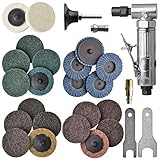
- 1/4 inch angle die grinder has a free speed of up to 20,000 RPM with 0.32HP motor, small size, and high power, suitable for...
- The 90-degree head design for reaching tight or angled grinding jobs, The pneumatic angle die grinder features a built-in speed...
- Ergonomically designed, lightweight aluminum body with low vibration design to reduce hand fatigue,durable ball-bearing...
Best for: Low-vibration grinder for tight spaces.
A 0.32 HP motor and 20,000 RPM free speed give the TOOLPEAK angle air die grinder enough pace for tight-space work without turning it into a bulky tool. The 90-degree head and lightweight aluminum body help it fit close to the job, while the built-in speed regulator gives the user more control during precision machining and engraving.
The low-vibration design is useful when you need steadier hand placement over longer runs, especially on detail passes where shaky input can leave uneven edges. A durable ball-bearing motor supports smoother operation, and the rear exhaust helps keep air away from the work surface. The included 22 pieces add practical value because the grinder comes with accessories suited to grinding and finishing tasks rather than arriving as a bare unit. The polished aluminum finish keeps the tool light in the hand, and the angled style makes it easier to reach recessed areas. It suits users who want a compact, controlled grinder for close-in shop work.
Pros
- 0.32 HP motor provides useful power for tight-space work
- 20,000 RPM supports fast finishing passes
- Built-in speed regulator improves control
- Low-vibration design helps steady the tool in hand
Cons
- The accessory set is useful, but it is still a pneumatic tool that needs compressed air to operate.
This model is a practical fit for users who want a compact grinder with a calmer feel in use. It is especially appealing for detail jobs where steady handling and access are the main priorities.
| Specification | Details |
|---|---|
| Brand | TOOLPEAK |
| Material | Aluminum |
| Power Source | Air Powered |
| Motor Power | 0.32 HP |
| Maximum Speed | 20,000 RPM |
| Color | Polished Color |
| Style | Angled |
| Included Pieces | 22 pcs |
I’d steer users toward this if they want a right-angle air grinder that feels controlled rather than aggressive. The low-vibration construction is the real draw for extended detail work. It is a sensible option for someone doing precision grinding, engraving, or cleanup in cramped spots and who already has air available.
9. Ingersoll Rand 3101G 1/4″ Collet Air Die Grinder

- 1/4" COLLET AIR DIE GRINDER: The Ingersoll Rand 3101G is a compact right-angle air die grinder with a 0.33 hp motor that delivers...
- PRECISE CONTROL & ACCESS: The self-locking throttle keeps the air grinder disengaged until activated, improving safety and...
- DURABLE & RELIABLE DESIGN: Made with an aluminum housing and precision ball-bearing construction, this die grinder tool is...
Best for: Compact right-angle shop grinder.
A 0.33 hp motor gives the Ingersoll Rand 3101G enough output for polishing work in automotive and fabrication settings. Its compact right-angle shape and 1/4-inch collet make it a focused air grinder for accessing tight spots while the lightweight 1.3-pound design keeps handling easy during repeated passes.
The 20,000 rpm speed places this grinder in the range where steady surface work is practical without feeling overly aggressive. A self-locking throttle keeps the tool disengaged until activated, which adds control when you move between parts or lay the grinder down. The right-angle configuration helps the head fit into areas where a straight body would interfere with nearby components. Because the tool is sold individually and the compressor is not included, it suits buyers who already have a pneumatic system and want a compact finishing tool. The black finish and lightweight build make it easy to integrate into a busy shop layout.
Pros
- 0.33 hp motor supports polishing and light grinding
- 20,000 rpm gives practical working speed
- 1.3-pound weight helps reduce fatigue
- Self-locking throttle adds activation control
Cons
- The air compressor is not included, so it requires existing pneumatic equipment.
This grinder suits users who want a simple, compact air tool for polishing and close-access work. It is a good match for shop environments where a lightweight right-angle body is more useful than a larger, more general-purpose tool.
| Specification | Details |
|---|---|
| Brand | Ingersoll Rand |
| Power Source | pneumatic-powered |
| Motor Power | 0.33 hp |
| Maximum Speed | 20,000 rpm |
| Item Weight | 1.3 pounds |
| Collet Size | 1/4 inch |
| Color | Black |
| Special Feature | Lightweight |
I’d put this in the hands of someone who wants a compact, familiar-feeling air grinder for polishing and light shop cleanup. The 1.3-pound weight and right-angle layout make it easy to live with during longer sessions. It’s a practical pick if you already have compressor support and want a straightforward grinder rather than a large kit.
10. Gunpla 1/4 inch Angle Air Die Grinder, 90 Degree Heavy

- 【High Quality】Specially treated core components enhance wear resistance and durability, ensuring long-lasting performance even...
- 【Various Accessories】5 types sand discs about 80 mesh brown corundum sand disc, 400 mesh blue nylon grinding disc, 180 mesh...
- 【Strong Applicability】The 90-degree head design for reaching tight or angled grinding jobs, widely used in automobiles...
Best for: Heavy-duty kit with varied abrasives.
Specially treated core components make the Gunpla 1/4-inch angle air die grinder a better fit for heavier use than many bare-bones compact grinders. The 90-degree head helps it reach tight or angled grinding jobs, and the included abrasive assortment adds immediate usefulness for grinding, deburring, engraving, polishing, cutting, and cleaning.
Five types of sand discs broaden what you can do with the tool: 80-mesh brown corundum, 400-mesh blue nylon, 180-mesh red nylon, 80-mesh torque zirconium corundum louver discs, and wool wheel discs. That variety matters when one job needs aggressive material removal and the next needs a finer finish. The air-powered layout suits shop users who already have compressed air, and the compact form keeps the grinder useful in automotive and motorcycle spaces where clearance is limited. The black finish and special core treatment point toward repeated use rather than a one-off task. It is a versatile option for users who want a grinder kit with broader abrasive choice.
Pros
- Specially treated core components support tougher use
- 90-degree head reaches tight and angled spots
- Five disc types handle multiple finishing stages
- Compact format suits vehicle and shop work
Cons
- The listing does not provide a speed figure, so buyers cannot compare its output directly against higher-RPM models.
This Gunpla kit works well for buyers who want broad abrasive variety and a compact right-angle grinder. It is especially useful when the job list includes everything from cleanup to polishing and cutting.
| Specification | Details |
|---|---|
| Brand | Gunpla |
| Power Source | Air Powered |
| Color | Black |
| Special Feature | Compact |
| Recommended Uses | Grinding, Deburring, Engraving, Polishing, Cutting, Cleaning |
| Head Type | 90-degree |
| Collet Size | 1/4 inch |
| Accessory Types | 5 types sand discs |
My opinion is that this one makes sense for users who want more abrasive variety than a basic grinder package usually offers. The disc mix is the big selling point because it supports several stages of work. If you handle mixed tasks on cars, bikes, or metal parts and want a compact right-angle setup, this is a versatile pick.
Quick Comparison Table of Top 90 Degree Die Grinders
| Product Name | Power Source | Collet Size | Speed | Best For | Check Price |
|---|---|---|---|---|---|
| WORKPRO Air Angle Die Grinder, 20000 | Corded electric | 1/4″ & 1/8 | 20000 RPM | Tight-space grinding | Check Price |
| Ingersoll Rand 301B 1/4″ Collet Air | Air powered | 1/4 | 21000 RPM | Compact grinding | Check Price |
| Chicago Pneumatic CP875 – Air Angle | Air powered | 1/4 | 22500 RPM | Fast polishing | Check Price |
| KJE Right Angle Die Grinder Kit | Air | 1/4″ & 1/8 | 25000 RPM | Multi-use kit | Check Price |
| Ingersoll Rand 5102MAX 1/4″ Collet Air | Air powered | 1/4 | 25000 RPM | Light-duty work | Check Price |
| SHALL Right Angle Die Grinder, 90 | Air | 1/4″ & 1/8 | 20000 RPM | Deburring and sanding | Check Price |
| PROSHI 1/4-Inch Mini Angle Grinder, Pneumatic | Air powered | 1/4 | Variable speed | Precise control | Check Price |
| 1/4 inch angle air die grinder | Air powered | 1/4 | 20000 RPM | Tight spaces | Check Price |
| Ingersoll Rand 3101G 1/4″ Collet Air | Pneumatic-powered | 1/4 | 20000 RPM | Automotive use | Check Price |
| Gunpla 1/4 inch Angle Air Die | Air powered | 1/4 | Not listed | Heavy-duty tasks | Check Price |
How to Choose the Right best 90 degree die grinder
Power and rpm range
Choose power around the work you do most, not the biggest number on the page. For heavy deburring, weld cleanup, and steady material removal, pick an air tool or motor with strong sustained output and enough torque to hold speed under load. For finishing and edge blending, a wide usable rpm range matters more than brute force, because controllable speed keeps stones and burrs from digging in.
Good picks offer smooth throttle response, variable speed, and stable power at the top and middle of the range; weak picks fade fast or surge under pressure. Choose high-output, speed-controlled models for mixed grinding shops, and compact high-speed units for fine detail work.
| Type | Best for |
|---|---|
| High-torque air model | Continuous grinding and deburring |
| Variable-speed electric model | Mixed tasks and finer edge control |
| High-rpm compact model | Light finishing in tight areas |
Head angle and access
Head angle matters when the job sits deep in a bay, bracket pocket, or welded corner. A true 90-degree head should place the accessory where your wrist stays clear of the work while the nose still reaches recessed spots. Check nose length first: shorter noses access tight welds and ports better, while longer noses add reach for awkward surfaces but reduce clearance.
Compact housing around the head improves control and line of sight, especially when you work one-handed. Choose a short-nose, slim-body grinder for engine bays and confined fabrication; choose a slightly longer head only when reach matters more than clearance.
| Head style | Best for |
|---|---|
| Short nose, compact head | Recessed welds, corners, tight bays |
| Mid-length nose | General fabrication and mixed access |
| Longer nose profile | Deeper reach on awkward parts |
Collet size and bit compatibility
Match the collet to the accessories you actually use, because fit decides both versatility and safety. Most buyers should verify whether the tool accepts the common shank sizes used by burrs, mounted stones, and small cutoff wheels, then confirm that the collet nut grips firmly without slippage. A good grinder holds the bit with a clean, secure clamp and uses a collet that releases without chewing up shanks.
Poor fit shows up as wobble, chatter, and poor cut quality. Choose the collet size that matches your most-used burrs, and pick a tool with easy accessory changes for work that switches between grinding and cutting.
| Collet size | Best for |
|---|---|
| Small shank | Fine burrs and detail finishing |
| Common mid-size shank | General shop burrs and stones |
| Accessory-compatible system | Mixed wheels, stones, and cutoff work |
Ergonomics and user comfort
Comfort decides how accurately you can work after the first few minutes. For one-handed control, pick a grip that fills the hand without forcing a squeeze, with a narrow body and textured surface that stays steady when oily. Low vibration is essential for precision because it keeps the bit on line and reduces numbness during long sessions.
Balance matters just as much: a tool that hangs nose-heavy pulls your wrist off axis. Lighter housings help in overhead or side-angle work, but not at the expense of stability.
Choose the lightest well-balanced grinder with a secure grip for frequent tight-space use, and a more substantial body only when you need extra steadiness.
- Narrow, non-slip grip for precise one-handed control
- Low vibration for longer sessions and cleaner edges
- Even balance so the nose does not pull downward
- Lightweight body for overhead and confined positions
Durability and maintenance
Durability starts with the housing and ends with how easily the tool stays serviced. A strong metal housing or reinforced composite shell protects the head in daily shop use, while quality internal bearings keep the spindle running smooth and reduce heat. Good maintenance features include easy lubrication access, simple disassembly for inspection, and seals that keep dust and grinding grit out of the motor or air path.
Weak picks feel loose, run rough, or collect debris quickly. Choose a grinder with sealed internals and clear service points for regular shop work, and pick a simpler, easy-to-open tool when you maintain your own equipment.
| Construction | Best for |
|---|---|
| Metal housing with quality bearings | Heavy daily use |
| Reinforced composite body | Lightweight handling with solid protection |
| Sealed, serviceable design | Dusty shops and regular maintenance |
Which Should You Choose?
- If you need one tool for both heavy grinding and fine finish work, choose a 90-degree air die grinder with both 1/4″ and 1/8″ collets.
- If you work in cramped engine bays or other tight spaces every day, choose a compact right-angle die grinder with a lightweight head and high RPM.
- If you want a kit that’s ready for sanding and polishing right away, choose a die grinder package that includes sanding discs, lubricant, and basic accessories.
- If you value stronger cut speed and more aggressive material removal, choose a higher-power 90-degree grinder with 22,000 RPM or more.
Quick Best 90 Degree Die Grinder Buying Checklist
- Confirm the head angle fits the tightest spaces you work in, such as brackets, exhaust areas, or engine bays.
- Choose the right power source by matching the tool to your workload, whether you need steady air power or cordless mobility.
- Verify collet compatibility so your favorite burrs, stones, and accessories lock in securely.
- Check comfort and balance to reduce hand fatigue during detailed grinding or long sessions.
- Look for smooth speed control to handle both aggressive material removal and delicate finishing.
- Review durability features like strong bearings, solid housing, and easy maintenance access.
How a 90 Degree Die Grinder Delivers Access in Tight Spaces
A 90 degree die grinder moves the motor housing perpendicular to the spindle, which makes the tool easier to position inside cramped engine bays, welded assemblies, and tubing corners. That right-angle head shifts the bulky body away from the work surface, so the operator can keep a more natural wrist position while still reaching flush edges and recessed areas. In practice, this layout is especially useful for deburring, porting, blending welds, and cleaning gasket surfaces where a straight grinder would collide with nearby parts.
The angle also helps control when using small burrs, carbide cutters, or mounted points. Because the tool presents the accessory from the side rather than straight ahead, it can improve sightlines and reduce accidental contact with surrounding material. That makes it a practical choice for precision finishing in automotive, fabrication, and maintenance work.
Pneumatic Versus Electric 90 Degree Die Grinders
90 degree die grinders are commonly sold in pneumatic and electric forms, and each has strengths that suit different shops. Pneumatic models are lightweight, compact, and well suited to continuous duty when paired with a capable air system. Electric versions avoid compressor dependence, which can be helpful for mobile work, home garages, or locations where air delivery is limited.
Both can perform the same tasks, but they behave differently under load and in day-to-day handling.
Understanding the trade-offs helps set expectations for torque, runtime, and setup. Pneumatic tools often feel more nimble, while electric tools are simpler to deploy. The table below shows the main practical differences.
| Type | Best for | Main trade-off |
|---|---|---|
| Pneumatic | Shop use with reliable air supply | Needs compressor capacity and hose management |
| Corded electric | Extended use without air tools | Limited by cord reach |
| Cordless electric | Portable work and quick jobs | Battery weight and runtime limits |
Accessory Compatibility and Collet Sizes Explained
Accessory fit matters as much as motor power because a 90 degree die grinder is only as useful as the bits it can securely hold. Most models use common collet sizes that match burr shanks, carbide cutters, and abrasive points. If the shank is too small for the collet, it can slip; if it is too large, it will not seat correctly.
A proper fit supports smoother rotation, better concentricity, and less vibration during detailed work.
It also helps to match accessory type to material. Carbide burrs are useful on steel and cast iron, while aluminum can load up some cutters if the flute design is not appropriate. Abrasive stones, flap accessories, and wire points each have their own speed and pressure requirements, so checking the tool’s rated accessory range is important before starting a task.
- Verify shank diameter before buying bits
- Use only accessories rated for the grinder speed
- Inspect collets for wear or debris
- Match the cutter profile to the material being removed
Routine Care That Keeps the Tool Running Smoothly
Regular maintenance helps a 90 degree die grinder stay balanced, quiet, and reliable. For pneumatic models, clean, dry air is important because moisture and debris can damage vanes and internal bearings. A few drops of approved tool oil before use may help reduce friction, but over-lubrication can attract contamination.
For electric models, keeping vents clear and cords or batteries in good condition prevents unnecessary heat buildup and power loss.
Regardless of drive type, the collet and spindle should be cleaned often so residue does not affect grip. Worn bearings, loose fasteners, and damaged hoses or cords should be addressed quickly because small problems can become vibration, noise, or uneven rotation. Storing the grinder in a dry case also protects the head and accessory interface from corrosion and dust.
Safety Practices for High-Speed Right-Angle Grinding
A 90 degree die grinder can remove material very quickly, so safe handling is essential. Eye protection is nonnegotiable because chips, grit, and broken abrasive fragments can eject at high speed. Hearing protection is also important, especially with pneumatic units that create sustained noise.
Gloves should be used with care; they can help with grip, but loose material can catch on rotating accessories. Close-fitting clothing and restrained hair reduce entanglement risk.
Before starting, confirm that the accessory is fully seated and rated for the tool’s speed. Let the grinder reach full speed before contacting the work, and keep the wheel or burr moving to avoid gouging or excessive heat. A firm stance and two-handed control, when possible, improve stability in tight or awkward positions.
- Wear eye and hearing protection
- Check accessory condition before use
- Keep hands clear of the rotating tip
- Disconnect power or air before changing bits
Frequently Asked Questions (FAQs)
What Is A 90 Degree Die Grinder Used For?
A 90 degree die grinder is used for grinding, deburring, sanding, and polishing in tight spaces where a straight tool cannot fit. Its angled head makes it especially useful for engine work, weld cleanup, and detailed metal finishing inside cramped areas.
Why Choose A 90 Degree Die Grinder Over A Straight Model?
A 90 degree die grinder is better than a straight model when access is limited and the work area is narrow. The angled head improves reach and hand positioning, which helps you control the bit more precisely around corners, flanges, and recessed surfaces.
What Power Type Is Best For A 90 Degree Die Grinder?
The best power type for a 90 degree die grinder depends on your workspace and workload. Air models often deliver strong continuous performance for shop use, while cordless versions offer portability and easier movement when you need freedom from hoses.
Which Collet Size Should I Look For?
The right collet size for a 90 degree die grinder depends on the accessories you plan to use. Common sizes support many burrs and stones, but you should choose a model that matches your most frequent bits so attachments fit securely and run true.
How Important Is Speed Control On A 90 Degree Die Grinder?
Speed control is very important on a 90 degree die grinder because different materials need different cutting rates. Variable speed helps you avoid overheating, chatter, and gouging, especially when switching between rough grinding and fine finishing work.
What Makes A 90 Degree Die Grinder Comfortable To Use?
A comfortable 90 degree die grinder has good balance, a slim grip, and low vibration for steady control. These traits reduce fatigue during prolonged use and help you guide the tool accurately in tight or awkward positions.
How Do I Maintain A 90 Degree Die Grinder?
A 90 degree die grinder stays reliable with regular cleaning, proper lubrication, and checks for worn collets or bearings. Removing dust and keeping moving parts serviced helps preserve speed, reduce noise, and extend tool life during frequent shop use.
Final Suggestions
In summary, the best 90 degree die grinder combines compact access, strong control, and dependable performance for precision work in tight spaces. It adds real value by making grinding, deburring, and finishing faster and more accurate across many shop tasks. Choose carefully, and you’ll have a tool that keeps improving every project you tackle.


